
Published by Panhandle Real Estate Investments, a locally owned real estate solutions company serving Escambia County, Santa Rosa County, Okaloosa County, and Bay County. We buy houses and land across the Florida Panhandle.
Last Updated: October 19, 2026
Table of Contents
- Can you sell with an open insurance claim?
- Who gets the insurance money?
- The catch: replacement cost
- Selling while suing your insurer
- Lawsuits that can hold up a sale
- Hurricane Isaias deadlines
- What you have to disclose
- Why storm-damaged houses are hard to sell
- Your options
- How selling to us works
- Local help
- FAQ
Yes, you can sell a house with an open insurance claim in Florida. The state’s assignment of benefits law makes an exception for a transfer to “a subsequent purchaser of the property with an insurable interest in the property following a loss,” so the law expects homes to change hands after a storm. The catch is money: insurers pay the rest of a dwelling claim “as work is performed and expenses are incurred,” and one Florida appeals court limited owners who sold before repairing to actual cash value.
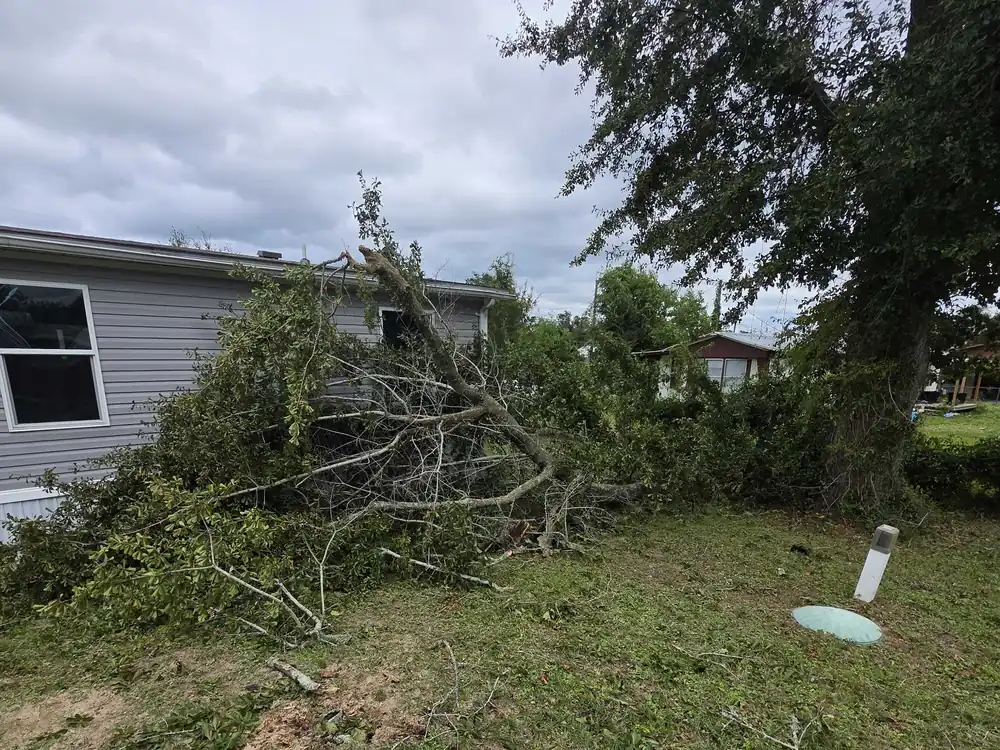
That question is suddenly real here. Hurricane Isaias made landfall near Destin around 8:30 p.m. on Friday, October 9, 2026, with 105 mph winds, and Gov. DeSantis said the strongest winds caused significant structural damage in parts of Santa Rosa and northeastern Escambia counties. Owners in Pensacola, Milton, Pace, Navarre and Gulf Breeze now face a damaged house, an open claim and a choice: rebuild or sell.
Key Takeaways
- You can sell. Florida law expressly anticipates a buyer who purchases after a loss.
- The claim stays yours unless you transfer it in writing, which the law allows for a buyer but your policy may limit.
- Selling unrepaired can cost you. One appeals court limited sellers to actual cash value; others disagree.
- Isaias deadlines: October 9, 2027 for a new claim, about April 9, 2028 for a supplemental one.
- Disclose known damage a buyer cannot readily see.
Can You Sell a House With an Open Insurance Claim in Florida?
Yes. The assignment of benefits statute specifically excludes a transfer to “a subsequent purchaser of the property with an insurable interest in the property following a loss” from its restrictions.
We have done it ourselves. Read how a Callaway seller kept the claim rights after Hurricane Michael when we bought the house.
The key point: the buyer gets the house, not your claim, unless the contract says otherwise. The contract is where you decide how the sale and the claim connect.
Who Gets the Insurance Money If You Sell Before the Claim Is Paid?
There are three common paths:
- You keep the claim. You sell and keep pursuing the claim for damage that happened while you owned the house, subject to your lender’s rights.
- You transfer the claim to the buyer in writing. For residential policies issued on or after January 1, 2023, Florida bars assigning post-loss benefits, for example to a contractor, but the buyer exception means the law does not forbid a transfer to your buyer. Your policy may still limit it. It depends on your policy or contract, so talk to a Florida attorney.
- You settle it through the deal. A lower price, a credit at closing or an escrow holdback, written into the contract.
Your mortgage lender has a say. Claim checks are typically made payable to both the owner and the lender, and the lender can hold the money and pay it out as repairs are made. On Fannie Mae loans, the servicer may release claim money in stages based on repair inspections, may not pay public adjuster fees from it without approval, and in a short sale pays out the remaining proceeds at closing. Other loans follow their own rules.
With lender-held claim money, it depends on your policy or contract, so talk to a Florida attorney, and get a written payoff statement showing how that money is applied. Talk to a CPA about how insurance money and a sale affect your taxes.
The Catch: Selling Before Repairs Can Shrink Your Replacement Cost Payout
Under section 627.7011 of the Florida Statutes, the insurer first pays at least the actual cash value of dwelling damage, minus your deductible. The rest, the recoverable depreciation that brings you up to replacement cost, is paid “as work is performed and expenses are incurred.” A total loss is different: the insurer must pay replacement cost without holding back depreciation.
In Universal v. Qureshi, decided by Florida’s Fourth District Court of Appeal on July 24, 2024, the homeowners sold before making repairs. The court held they were not entitled to repair costs unless and until work was performed and expenses incurred, which limited them to actual cash value.
Other Florida courts disagree. The Third District in Tio (2020), the Second District in Brito (2025) and the Sixth District in Rodriguez (2026) allowed replacement cost evidence when an insurer wrongly denied a claim. Rodriguez certified conflict with Qureshi and noted that Qureshi involved a sale. As of October 2026, we found no Florida Supreme Court decision resolving the split.
If replacement cost is in dispute, it depends on your policy or contract, so talk to a Florida attorney before you sell unrepaired. This is general information, not legal advice. For your situation, talk with a Florida attorney.
Can You Sell Your House While Suing Your Insurance Company?
Yes. The Qureshi homeowners sold, and their case still went to trial and then to appeal. A claim dispute is about money under the policy.
Suing is a bigger financial decision than it used to be. Since December 16, 2022, one-way attorney fee rules no longer apply to lawsuits under residential property policies, and a 2023 law repealed the one-way fee statutes outright.
A cheaper first step is Florida’s free mediation program. It opens once the claim is paid or denied, the insurer pays the cost, the result is not binding, and you have 3 business days to back out of a settlement unless you have cashed the check. For free legal help, call the Florida Disaster Legal Aid Helpline at 833-514-2940.
Lawsuits That Can Hold Up a Sale
Some lawsuits tie up the property itself through a lis pendens, a recorded notice that a lawsuit involves the property. Foreclosure, partition and quiet title suits are the usual examples.
Under section 48.23, a lis pendens not based on a recorded document, such as a mortgage, expires after 1 year unless extended, and a court can discharge it. Foreclosure suits rest on a recorded mortgage.
An insurance claim dispute is different. It is about money owed under the policy, not who owns the house.
Hurricane Isaias Deadlines Keep Running After You Sell
Under section 627.70132, a new or reopened claim must be reported within 1 year after the date of loss, and a supplemental claim within 18 months. For hurricanes, the date of loss is the landfall date, so for Hurricane Isaias that means October 9, 2027 and about April 9, 2028. Nothing in the statute pauses the clock for a sale.
Your insurer has deadlines too: acknowledge a claim within 7 days and pay or deny it within 60 days of notice, with up to 30 more days allowed after a declared emergency.
Federal flood (NFIP) policies require a signed, sworn proof of loss within 60 days after the loss. Whether a flood claim can be pursued after a sale depends on your policy or contract, so talk to a Florida attorney.
If you hire a public adjuster, the fee is capped at 10% of claim payments for claims from a declared emergency during the year after the declaration, and 20% otherwise, and in an emergency you can cancel within 30 days of the date of loss or 10 days of signing, whichever is longer. It also helps to know how your hurricane deductible works.
What You Have to Disclose When Selling a Storm-Damaged House in Florida
In Johnson v. Davis (1985), the Florida Supreme Court held that a seller who knows of facts that materially affect value, are not readily observable and are not known to the buyer must disclose them. Known storm damage a buyer cannot readily see is that kind of fact.
Since October 1, 2024, Florida sellers must also give a flood disclosure at or before signing. It asks whether they filed a flood insurance claim, including with the NFIP, or received federal flood assistance, including from FEMA. It covers flood, not wind.
Buyers often find out anyway: Citizens checks LexisNexis loss history to spot existing damage.
Why Storm-Damaged Houses Are Hard to Sell on the Open Market
A buyer using a mortgage has to insure the house. Citizens says a home with an open claim may still be eligible, but unrepaired structural damage goes to underwriting, and proof of repair can include a 4-point inspection dated after the loss that shows no deficiencies. Citizens requires 4-point inspections for homes more than 20 years old.
If you keep the house while you repair, an insurer may not cancel or nonrenew after hurricane damage in a declared emergency until 90 days after the home is repaired, with exceptions including nonpayment, claim fraud, unreasonably delaying repairs or policy limits paid.
The standard contract does not fix it either. The Florida Realtors AS IS contract’s risk of loss clause covers damage after the contract’s effective date: restoration up to 1.5% of the price is the seller’s job, and above that the buyer can take the house as-is plus the 1.5% or cancel and get the deposit back. Existing Isaias damage is not covered by that clause, so it gets handled through price, credits or escrow.
Sell As-Is, Repair Then Sell, or Rebuild and Stay: Your Options
If you decide to sell a house as-is in Florida, that is one of four paths, and not always the best one.
| Repair and stay | Repair, then list | List as-is with an agent | Sell as-is to a cash buyer | |
|---|---|---|---|---|
| Money up front | Deductible plus uncovered repairs | Same, plus carrying costs | Carrying costs until closing | None |
| Repairs and claim | You | You | Claim: you. Repairs: the buyer | Repairs: us. Claim: as the contract says |
| Timeline | Longest | Long | Uncertain | Usually fastest |
| Likely price | No sale | Usually highest | Lower | Usually lowest |
| Best for | Staying, with a solid claim | Owners who can fund repairs | Owners with time | Owners done with repairs and adjusters |
A cash sale usually nets less than a repaired home sold on the open market. In exchange you skip repairs, contractors and carrying costs. If the claim covers most of the work and you want to stay, repairing is usually the better call, and we would tell you so.
For more on the tradeoffs, see our guide to deciding whether to repair, file a claim or sell after a hurricane and our post on selling a house as-is in Pensacola when it needs repairs. If selling as-is fits, we can help you sell your house fast in Pensacola without fixing anything first.
How Selling to Panhandle Real Estate Investments Works
- Tell us about the house and where the claim stands. It takes a few minutes, with no commitment.
- We review the damage and make a fair as-is cash offer, with how the claim is handled written into the contract.
- You close when you are ready. We handle the paperwork.
Have your own attorney review the claim language in any contract, ours included. Selling to us is not the right move for everyone; if your claim is solid and you want to stay, rebuilding is usually better.
Local Help in Pensacola, Escambia and Santa Rosa
Our page of free Hurricane Isaias resources for Pensacola and Santa Rosa County lists hotlines, free tarping, debris rules and insurance help. For insurance questions, Florida’s Department of Financial Services runs a free insurance consumer helpline at 1-877-693-5236.
We also buy in Milton, Pace and Navarre. Here is what selling a house as-is in Milton looks like with us.
Frequently Asked Questions
Can I sell my house with an open insurance claim in Florida?
Yes. Florida’s assignment of benefits law expressly anticipates a sale to a buyer who purchases after a loss. The buyer gets the house, not your claim, unless the contract says otherwise. If replacement cost is in dispute, talk to a Florida attorney before selling.
Who gets the insurance money if I sell my house before the claim is paid?
Usually you do, unless the contract says otherwise. You can keep the claim, transfer it to the buyer in writing if your policy allows, or settle it through the price or a credit. Ask your mortgage lender for a written payoff statement before closing.
Can I sell my house while suing my insurance company?
Yes. In one Florida case, the homeowners sold the house and their claim still went to trial and appeal. Suing costs more than it used to, so Florida’s free mediation program, which opens once a claim is paid or denied, is a cheaper first step.
Will I lose replacement cost if I sell without making repairs?
You might. Florida insurers pay the replacement cost portion of a dwelling claim as work is performed, and one appeals court limited sellers who had not repaired to actual cash value. Other Florida appeals courts disagree, so talk to a Florida attorney first.
Do I have to disclose an insurance claim when selling a house in Florida?
You have to disclose known facts that materially affect the value and are not readily observable, which can include storm damage. Florida sellers also give a flood disclosure asking whether they filed a flood insurance claim or received federal flood assistance.
How long do I have to file a Hurricane Isaias insurance claim?
You have 1 year from the date of loss to report a new claim and 18 months for a supplemental claim. For Hurricane Isaias, the date of loss is the October 9 landfall, so that means October 9, 2027 and about April 9, 2028.
An open claim does not lock you into rebuilding. You can sell, keep the claim or transfer it in writing, and the deadlines run either way. The question that matters most is whether you can afford to give up replacement cost, so answer that before you sign anything.
Weighing Whether to Rebuild or Sell?
If you would rather not manage contractors, adjusters and months of repairs, we buy Pensacola-area houses as-is, open claims included. We will make a no-obligation cash offer and show you in writing how your claim is handled in the contract.
Prefer to talk? Call us at (850) 778-2212.

About Panhandle Real Estate Investments
I’m Peyton Saluto, founder of Panhandle Real Estate Investments. For over seven years, I’ve helped homeowners across the Florida Panhandle find fair and stress-free ways to sell their homes—no repairs, no commissions, and no pressure. My goal is always to put people first and make a real difference in our communities by restoring distressed properties and rebuilding neighborhoods. If you’re thinking about selling, reach out for a no-obligation cash offer. I’d love the opportunity to help you find the best path forward.