
Published by Panhandle Real Estate Investments, a locally owned real estate solutions company serving Escambia County, Santa Rosa County, Okaloosa County, and Bay County. We buy houses and land across the Florida Panhandle.
Last Updated: October 29, 2026
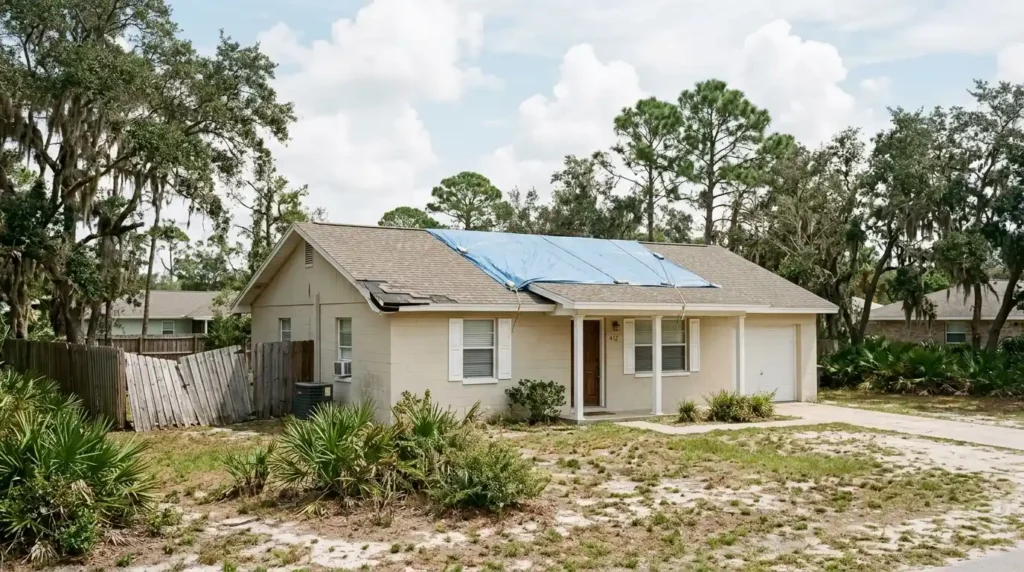
Under Florida law, your insurance company has 60 days after it receives notice of a claim to pay it or deny it, in whole or in part. Hurricane Isaias came ashore near Destin on October 9, so for a lot of homeowners in Pensacola, Navarre, Fort Walton Beach, and Panama City, that clock runs out in early December. Some already have the letter.
It might be a flat denial. It might be a “partial denial” that pays for the fence and not the roof. Or it might be a check so far below your contractor’s estimate that it cannot fix the house. None of those letters is the last word, and Florida gives homeowners more ways to push back than most people realize.
This guide covers why claims get denied or underpaid, what your insurer owes you under Florida law, what to do next, and what to do if the fight starts costing more than the house is worth.
Key Takeaways
- A denial has to come with a reason. Florida law requires your insurer to explain in writing which part of the policy it relied on.
- You are entitled to the adjuster’s estimate. Insurers must send you a copy of any detailed estimate within 7 days after it is written.
- Mediation is free for you. The state’s program is paid for by the insurer, and it is not binding.
- Deadlines still apply. For Isaias, new claims are due by October 9, 2027, and supplemental claims by April 2028.
- A claim dispute does not stop a sale. You can usually keep your claim rights in writing if you sell.
Table of Contents
- Why hurricane claims get denied or underpaid
- What your insurer owes you under Florida law
- What to do after a denial or a low offer
- Mediation, appraisal, public adjuster, or attorney
- When the fight costs more than the house
- How selling to Panhandle Real Estate Investments works
- Hurricane Isaias deadlines for Panhandle homeowners
- Frequently asked questions
Why Hurricane Claims Get Denied or Underpaid
Most bad claim letters after a storm come down to a handful of reasons. Knowing which one you got tells you where to push.
The damage is below your deductible. Florida hurricane deductibles are usually a percentage of your dwelling coverage, not a flat dollar amount, so moderate wind damage can fall entirely under it. Technically that is not a denial, but the result is the same. Our guide to how Florida hurricane deductibles work shows how to check the math.
The insurer blames age, not the storm. Policies cover sudden damage, not wear and tear. On an older roof, an adjuster may call missing shingles “deterioration” rather than wind damage. If your roof is near the end of its life, read how roof age affects Florida insurance before you argue the point.
It was water, not wind. Homeowners insurance does not cover flood damage, and storm surge counts as flood. If the insurer says the water came in from the ground up, that part of the loss belongs to a separate flood policy, if you have one.
Paperwork or timing. Missing photos, an unanswered request for documents, or a claim reported too late can all lead to a denial. Florida requires notice of a new claim within 1 year after the date of loss.
Underpaid, not denied. The insurer accepted the claim but its estimate leaves out items, prices the work low, or takes off for depreciation. On a replacement cost policy, Florida insurers must initially pay at least the actual cash value of the loss, with more paid as the repairs are done, so a first check that looks low may not be the final number.
What Your Insurer Owes You Under Florida Law
Florida puts the insurer on a clock. These deadlines come from section 627.70131 of the Florida Statutes, and the state requires insurers to send you a Homeowner Claims Bill of Rights within 14 days after you first report a claim.
The Florida claim clock
| What the insurer must do | Deadline |
|---|---|
| Acknowledge your claim communication | Within 7 calendar days |
| Begin its investigation | Within 7 days after receiving your proof of loss |
| Complete any physical inspection | Within 30 days after receiving your proof of loss |
| Send you a copy of its adjuster’s detailed estimate | Within 7 days after the estimate is written |
| Pay or deny the claim, in whole or in part | Within 60 days after notice of the claim |
| Explain any denial or partial denial | In writing, based on the policy, the facts, or the law |
| Pay interest on late payments | From the date it received notice of the claim |
Two details matter after a big storm. First, if the insurer pays less than its own adjuster’s estimate, it has to explain the difference in writing. Second, the 60 days can be extended when state regulators find that a catastrophe put the decision beyond the insurer’s control, so a late answer is not always a violation.
What to Do After a Denial or a Low Offer
If you think the decision is wrong, work through these steps in order.
- Read the letter line by line. Find the exact policy section the insurer relied on. “Wear and tear,” “flood exclusion,” and “below deductible” each call for a different response.
- Get the insurer’s estimate in writing. You are entitled to a copy of the adjuster’s detailed estimate. Ask for every inspection report and photo too.
- Get your own estimate. A licensed Florida contractor’s written estimate, compared line by line with the insurer’s, shows exactly where the gap is.
- Answer in writing. Send the missing documents or your estimate and ask the insurer to reconsider. If you find damage nobody inspected, report it as a supplemental claim.
- Request mediation. Once the insurer has paid or denied the claim, you can ask the Florida Department of Financial Services for free mediation.
- Check your policy for an appraisal clause. Many homeowners policies have one, and it changes your options.
- Talk to a licensed professional before a deadline passes. A public adjuster or a Florida insurance attorney can tell you whether the dispute is worth pursuing.
While you work through it, keep protecting the house. Florida’s Homeowner Claims Bill of Rights advises homeowners to make and document the emergency repairs needed to prevent further damage, and to keep every receipt and photo.
Mediation, Appraisal, Public Adjuster, or Attorney?
Mediation. In Florida’s property insurance mediation program, the insurer must bear the cost of the conference. It is not binding, and if you settle, you have 3 business days to back out unless you have already cashed the check.
Appraisal. Many policies send disputes about the amount of the loss to appraisal, where each side picks an appraiser and an umpire breaks ties. The Legislature itself calls it a potentially expensive and time-consuming adversarial process, so read the clause before you invoke it.
Public adjuster. A licensed public adjuster works for you and takes a share of what the claim pays. For claims made in the year after a Governor’s emergency declaration, Florida caps that fee at 10 percent of the claim payments.
Attorney. Before suing over a property claim in Florida, you must file a notice of intent to initiate litigation at least 10 business days before filing suit. An attorney fits best for a full coverage denial or a large amount in dispute.
| Path | Who pays | Binding? | Usually fits |
|---|---|---|---|
| State mediation | The insurer pays the conference cost | No | A gap in price or scope you want settled fast |
| Appraisal | Set by your policy’s appraisal clause | Usually decides the amount of loss | Coverage accepted, amount disputed |
| Public adjuster | A share of the claim payments, capped by law | No, they negotiate for you | Large or complicated claims |
| Attorney | Depends on the fee agreement | A court decides if it does not settle | Full denials and large disputes |
When the Fight Costs More Than the House
Some disputes are worth months of effort. Others are not, especially when the house keeps deteriorating while the mortgage keeps coming due. You have three honest paths.
Dispute it and repair. If the gap is large and your documentation is strong, pursue it and fix the house with what you recover. This usually nets the most if you plan to stay.
Settle, repair, then list. A repaired house sells to the full retail market. The tradeoff is time, carrying costs, and the risk that repairs stall.
Sell as-is and keep the claim. A cash buyer can take the house with the damage in place, and the claim dispute can continue after closing if the contract says so. Read what to know before selling with a claim still open first. In Okaloosa County, you can sell your Fort Walton Beach house as-is without settling the claim first.
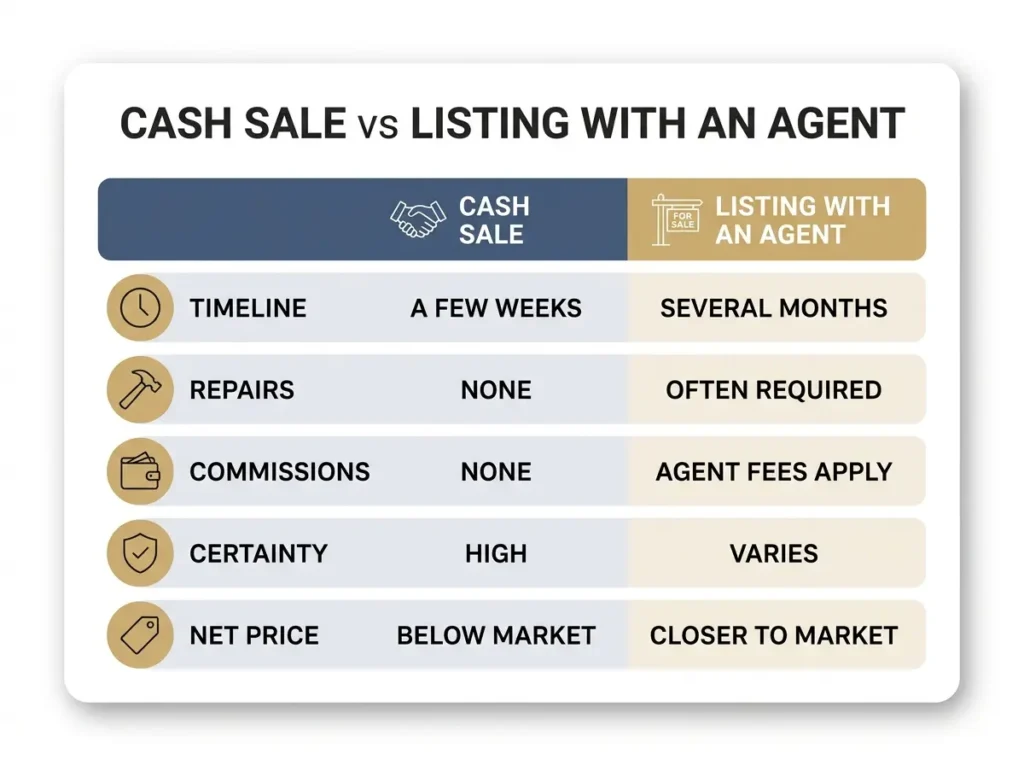
| Factor | Cash Sale (As-Is) | Listing With an Agent |
|---|---|---|
| Timeline | Often within a few weeks | Typically 60 to 120 days or more |
| Storm repairs | None, we buy as-is | Usually needed before a financed buyer can close |
| Claim dispute | You can keep the claim rights in writing | Has to be disclosed and often settled first |
| Commissions | None | Typically 5 to 6 percent |
| Certainty of close | High | Subject to financing, inspection, appraisal |
| Net price | Below market, no repairs or fees | Closer to market, after repairs and costs |
For a side-by-side on the tradeoffs, we keep an honest cash offer versus agent listing comparison that lays it out without the sales spin. If your dispute is likely to pay for the repairs, fixing the house is usually the better financial move.
How Selling to Panhandle Real Estate Investments Works
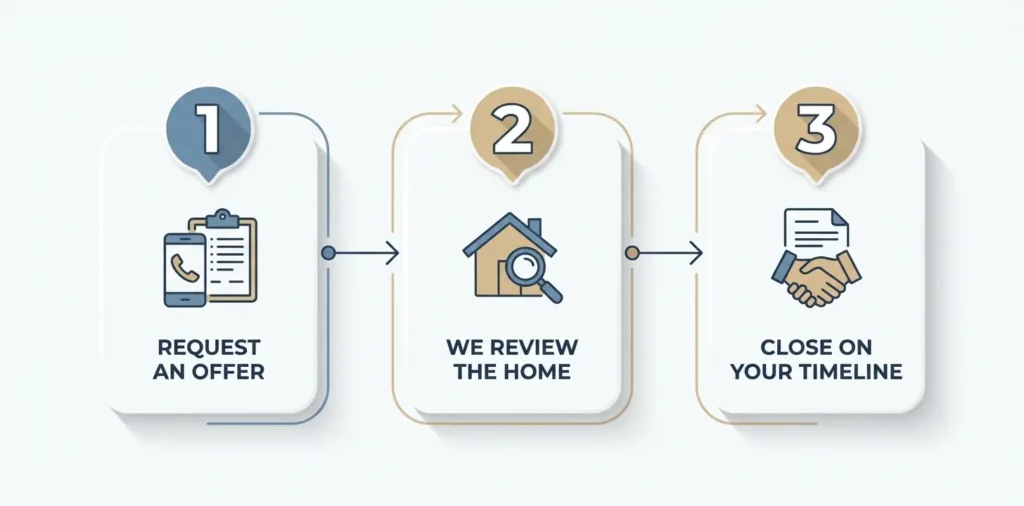
If selling as-is turns out to be the right fit, the process is short and there is no obligation to accept anything.
- Request an offer. Tell us about the house, the damage, and where the claim stands, including any denial letter or estimate. It takes a few minutes and there is no commitment.
- We look at the damage and the numbers. We estimate the repairs ourselves and build them into a fair cash offer, with the math shown rather than hidden.
- Close on your timeline. If the offer works, we handle the paperwork, your claim rights stay with you in writing if you want them, and you close when you are ready.
If your dispute is strong and you want to stay in the house, keep fighting the claim. We will tell you plainly when a sale is not your best move.
Hurricane Isaias Deadlines for Panhandle Homeowners
For hurricane claims, Florida sets the date of loss as the date the hurricane made landfall. For Hurricane Isaias, that is October 9, 2026, whether your house is in Escambia, Santa Rosa, Okaloosa, or Bay County.
Isaias claim dates to put on your calendar
- Early December 2026: 60-day decisions come due for claims reported in the first weeks after landfall.
- October 9, 2027: last day to report a new or reopened Isaias claim.
- April 9, 2028: about the last day to report a supplemental claim for additional Isaias damage, 18 months after landfall.
Panhandle homeowners have been here before. After Hurricane Michael in Bay County, we met owners whose claims stayed open for years while the houses sat.
If you want local help sorting out where to start, our guide to repairing, filing a claim, or selling after Hurricane Isaias lists free cleanup help and state hotlines. For claim questions, call the Florida Department of Financial Services Insurance Consumer Helpline at 1-877-693-5236. For free legal help, the Florida Disaster Legal Aid Helpline is 833-514-2940.
Frequently Asked Questions
What can I do if my hurricane claim is denied in Florida?
Start with the denial letter, which must explain in writing which part of the policy the insurer relied on. Gather your photos and a contractor’s estimate, ask for the adjuster’s detailed estimate, and request free mediation through the Florida Department of Financial Services. If mediation fails, appraisal, a public adjuster, or an attorney are the next steps.
How long does an insurance company have to pay a hurricane claim in Florida?
Florida law gives your insurer 60 days after it receives notice of the claim to pay or deny it, in whole or in part, unless factors beyond its control apply. Payments made after that deadline generally carry interest from the date the claim was reported. The insurer must also acknowledge your communications within 7 days.
Can I reopen or add to a hurricane claim in Florida?
Yes, within limits. A new or reopened claim must be reported within 1 year after the date of loss, and a supplemental claim for additional damage from the same storm within 18 months. For Hurricane Isaias, the date of loss is the October 9, 2026 landfall, so those deadlines fall in October 2027 and April 2028.
Is insurance mediation free in Florida?
For the homeowner, generally yes. Under Florida law, the insurer pays the cost of the mediation conference in the Department of Financial Services program, which opens once your claim has been paid or denied. Mediation is not binding, and if you settle, you have 3 business days to change your mind unless you have cashed the check.
Can I sell my house while I dispute the insurance claim?
Yes. A claim dispute does not stop a sale. In most cases you can keep your claim rights in writing in the purchase contract, so the dispute continues after closing, or you can transfer the claim to the buyer, which Florida law allows. Have a Florida attorney review the contract wording before you sign.
A denial or a low check is the start of a process, not the end of your claim. Read the letter, get the estimates in writing, use the free mediation program, and decide with real numbers whether the house is worth the fight.
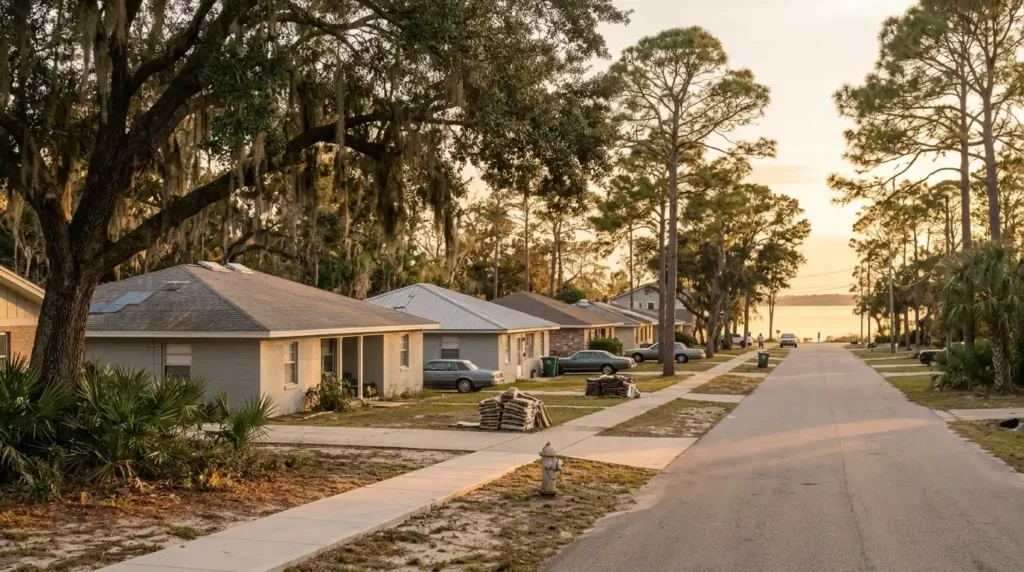
If the claim fight is costing more than it is worth and you want to know what your Pensacola, Navarre, Fort Walton Beach, or Panama City house is worth as-is, we are happy to give you a straightforward answer. No obligation, no pressure. Request a cash offer from Panhandle Real Estate Investments.

About Panhandle Real Estate Investments
I’m Peyton Saluto, founder of Panhandle Real Estate Investments. For over seven years, I’ve helped homeowners across the Florida Panhandle find fair and stress-free ways to sell their homes—no repairs, no commissions, and no pressure. My goal is always to put people first and make a real difference in our communities by restoring distressed properties and rebuilding neighborhoods.
If you’re thinking about selling, reach out for a no-obligation cash offer. I’d love the opportunity to help you find the best path forward.