
Published by Panhandle Real Estate Investments, a locally owned real estate solutions company serving Okaloosa County, Escambia County, Santa Rosa County, and Bay County. We buy houses and land across the Florida Panhandle.
Last Updated: November 5, 2026
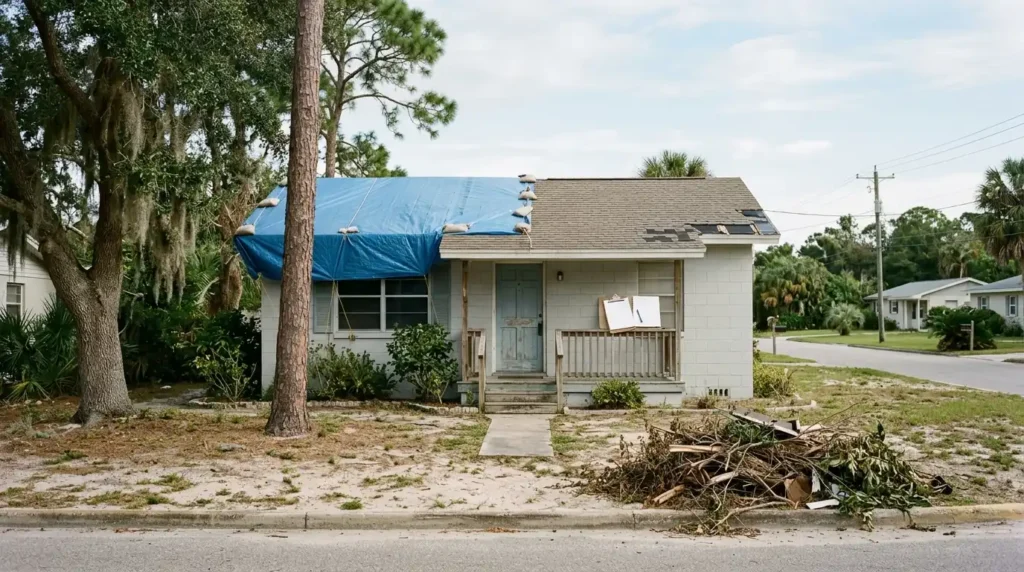
Almost four weeks after Hurricane Isaias, the knocks have not stopped. In Fort Walton Beach, Destin, Navarre, and Pensacola, homeowners are still finding public adjusters at the door, cards in the mailbox, and calls that promise a bigger insurance check, and the pitch gets louder as the first claim decisions arrive. Some of those adjusters will genuinely help. Others will take a cut of money you would have gotten anyway.
Florida has a lot of rules about public adjusters, and most homeowners have never heard of them. The fee is capped by law, you have the right to cancel, and there are situations where an adjuster is entitled to nothing at all. Knowing those rules is the difference between a good hire and an expensive mistake.
This guide explains what a public adjuster actually does, what Florida law lets them charge, your rights if you sign, and an honest look at when hiring one pays off and when it does not.
Key Takeaways
- A public adjuster works for you, not your insurer, and gets paid a percentage of your claim.
- Florida caps the fee at 10 percent for claims made within a year of a declared state of emergency, like Isaias, and 20 percent otherwise.
- They get zero percent of any money your insurer paid or agreed in writing to pay before you signed with them.
- You can cancel. After a declared emergency, you have 30 days after the date of loss or 10 days after signing, whichever is longer.
- It is not always worth it. On small claims, or when the insurer’s offer is already fair, the fee can cost more than it gains.
Table of Contents
- What a public adjuster actually does
- What a public adjuster costs in Florida
- Your rights under Florida law
- When a public adjuster is worth it, and when it is not
- If the claim still does not cover the damage
- How selling to Panhandle Real Estate Investments works
- Fort Walton Beach, Destin, Pensacola, and Panama City specifics
- Frequently asked questions
What a Public Adjuster Actually Does
After a storm, the adjuster who inspects your house usually works for your insurance company. A public adjuster is the opposite: someone you hire to prepare, document, and negotiate your claim on your behalf. They measure the damage, build their own estimate, gather the paperwork, and push back when the insurer’s number looks low.
They are licensed by the state. Under Florida law, an applicant has to pass an examination and file a 50,000 dollar surety bond to be licensed as a public adjuster. Before you sign anything, look the person up in the Florida Department of Financial Services licensee search and confirm the license is active.
What they do not do matters just as much. A public adjuster is not a lawyer and may not give legal advice, and Florida law bars them from contracts that give them the power to choose who does your repair work. If someone at your door wants to adjust your claim and also run the roofing job, that is a red flag.
What a Public Adjuster Costs in Florida
Public adjusters are paid a percentage of what the insurer pays on your claim. Florida does not leave that percentage open. Section 626.854 of the Florida Statutes caps the fee at 10 percent for claims made during the year after a governor’s state of emergency declaration, and at 20 percent for other claims. Hurricane Isaias claims made within that first year fall under the 10 percent cap.
Florida public adjuster fee caps
| Situation | Maximum fee |
|---|---|
| Claim made within one year after a declared state of emergency | 10 percent of claim payments |
| Any other claim | 20 percent of claim payments |
| Insurer pays, or agrees in writing to pay, at or above the policy limit for that coverage within 14 days of the loss or 10 days after you sign, whichever is later | 1 percent |
| Insurer paid, or agreed in writing to pay, before you signed the adjuster’s contract | 0 percent |
That last row is the one to remember. If your insurer has already offered or paid an amount in writing, a public adjuster cannot take a cut of it. Their fee only comes from the additional money they help you recover, so ask any adjuster to put that in writing before you sign.
The fee also comes out of the same check that has to cover your hurricane deductible and your repairs. Before you decide, it helps to know how the hurricane deductible is calculated, because on a modest claim the deductible plus a 10 percent fee can leave very little for the actual work.
Your Rights Under Florida Law
The same statute gives you real protections. These are the ones that matter most in the weeks after a storm:
- A written contract. The agreement has to be in writing, with the cancellation terms printed in large bold type right above where you sign.
- The right to cancel. Normally you can cancel within 10 days after signing. After a declared emergency, the window is 30 days after the date of loss or 10 days after signing, whichever is longer. For damage from Isaias’s October 9 landfall, the 30-day window runs out in early November, so for a contract signed now, the 10 days after signing is usually what counts.
- A written estimate within 60 days. The adjuster has to give you a written estimate of the loss within 60 days. If they do not, you can cancel without added fees.
- Limited sales hours. A public adjuster may only solicit Monday through Saturday, between 8 a.m. and 8 p.m. A knock on a Sunday or after dark breaks that rule.
- You can still talk to your insurer. The insurer is entitled to interview you directly about the claim, and it may not shut your adjuster out of in-person meetings with you.
If an adjuster pressures you to sign on the spot, will not leave a copy of the contract, or is vague about the fee, walk away. A good one will be fine with you reading the contract overnight and checking the license first.
When a Public Adjuster Is Worth It, and When It Is Not
There is no single right answer, and anyone who says you always need one, or never do, is selling something. Here is the honest split.
Usually worth considering
- A large or complicated claim, like roof, water, and interior damage together, with dozens of line items.
- An insurer’s estimate that looks clearly low, and you do not have the time or know-how to document why.
- You are displaced, working, or caring for family and cannot manage the claim yourself.
Usually not worth it
- The damage is close to your hurricane deductible, so there is little extra money to recover.
- The insurer has already offered a fair amount in writing. The adjuster gets nothing on that offer, so the extra time may not pay off.
- The claim is already in a legal dispute. A public adjuster cannot give legal advice, so a lawyer is the right call.
You also have free options first. The Florida Department of Financial Services runs a property insurance mediation program, and under section 627.7015 the insurer must bear the cost of the mediation conference. Many policies also have an appraisal clause for disputes over the amount of the loss. If your claim was already denied or came in low, our guide to your next steps after a denied or underpaid hurricane claim walks through mediation, appraisal, and the deadlines.
If the Claim Still Does Not Cover the Damage
Sometimes even a well-argued claim leaves a gap: the deductible, the fee, and the repairs add up to more than the insurer will pay. At that point you have three honest choices.
Repair and stay. Cover the gap from savings and keep the house. This is the right move when the gap is manageable and you plan to stay for years.
Repair, then sell. A repaired house reaches the full retail market, but you carry the costs and manage contractors in the meantime.
Sell as-is and keep the claim. You can sell the house with the damage in place and, in most cases, keep the rights to the claim in writing, which we explain in our guide to selling a house with an open insurance claim. In Okaloosa County, you can sell your Fort Walton Beach house as-is without finishing the repairs first.
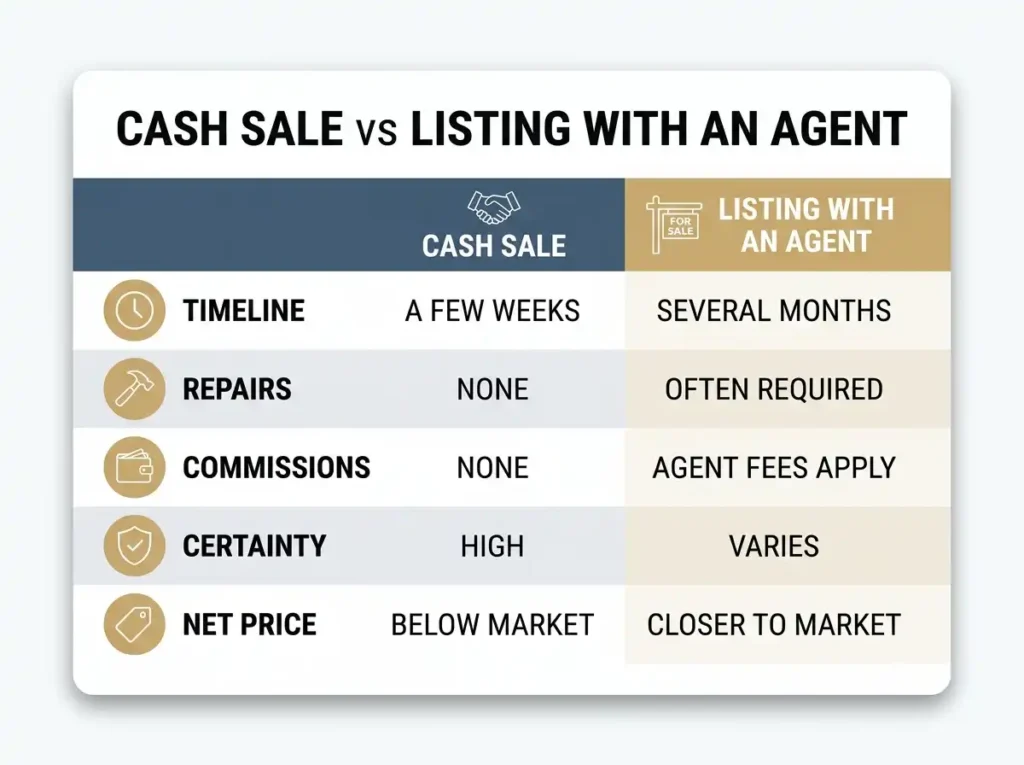
| Factor | Cash Sale (As-Is) | Listing With an Agent |
|---|---|---|
| Timeline | Often within a few weeks | Typically 60 to 120 days or more |
| Storm repairs | None, we buy as-is | Usually needed before a financed buyer can close |
| Open insurance claim | You can keep the claim rights | Has to be sorted out and disclosed for the buyer |
| Commissions | None | Typically 5 to 6 percent |
| Certainty of close | High | Subject to financing, inspection, appraisal |
| Net price | Below market, no repairs or fees | Closer to market, after repairs and costs |
For a side-by-side on the tradeoffs, we keep an honest cash offer versus agent listing comparison that lays it out without the sales spin. If the claim covers the repairs, fixing and staying is usually the better financial call.
How Selling to Panhandle Real Estate Investments Works
If selling as-is turns out to be the right fit, the process is short and there is no obligation to accept anything.
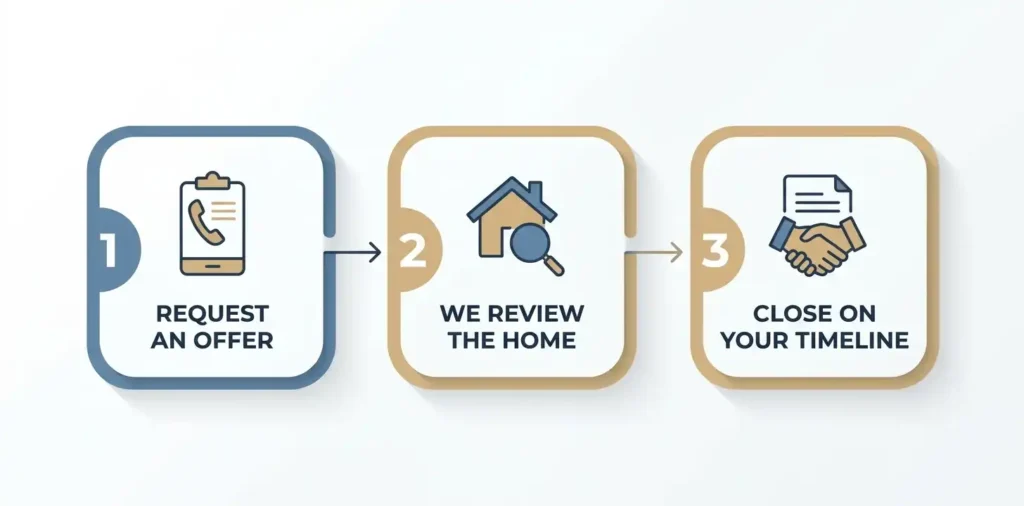
- Request an offer. Tell us about the house, the storm damage, and where your claim stands, including whether a public adjuster is involved. It takes a few minutes and there is no commitment.
- We look at the damage and the numbers. We estimate the repairs and build them into a fair cash offer, with the math shown rather than hidden.
- Close on your timeline. If the offer works, we handle the paperwork, your claim rights stay with you in writing if you want them, and you close when you are ready.
If your claim is on track and covers the work, you probably do not need us, and we will tell you that plainly.
Fort Walton Beach, Destin, Pensacola, and Panama City Specifics
Isaias came ashore near Destin, so Okaloosa County, along with Santa Rosa and Escambia, has carried the heaviest claim volume. That is also where the door knocking has been heaviest. Expect several adjusters, roofers, and tree crews in the same week, and take the time to check each license before you sign anything.
Bay County homeowners have seen this before. After Hurricane Michael, many Panama City owners dealt with long, contested claims for years. Florida has tightened its rules on adjusters and contractors since then, and the protections in this post are part of that.
If a tree caused your damage, start with our guide to who pays when a tree falls on your house, because tree claims have their own removal limits and deductible rules.
Frequently Asked Questions
How much does a public adjuster charge in Florida?
Florida caps public adjuster fees at 10 percent of claim payments for claims made within a year after a declared state of emergency, and 20 percent for other claims. The fee drops to 1 percent in some fast policy-limit payouts, and to zero on any amount the insurer paid or agreed in writing to pay before you signed.
Is a public adjuster worth it?
It depends on the claim. For large, complicated claims where the insurer’s estimate looks low, a public adjuster can recover more than the fee costs. For small claims near your deductible, or when the insurer has already offered a fair amount, the fee can outweigh the gain. Free DFS mediation is worth considering first.
Can I cancel a public adjuster contract in Florida?
Yes. Normally you can cancel within 10 days after signing. After a declared state of emergency, you have 30 days after the date of loss or 10 days after signing, whichever is longer. You can also cancel without added fees if the adjuster does not give you a written estimate within 60 days.
Do public adjusters get paid on money my insurer already offered?
No. Florida law sets the fee at zero percent on any amount the insurer paid, or agreed in writing to pay, before you signed the public adjuster’s contract. Their fee only comes from the additional money they help you recover, so get any offer from your insurer in writing and ask the adjuster to confirm this in the contract.
Do I need a public adjuster or an attorney?
A public adjuster documents and negotiates the amount of the claim. An attorney handles legal disputes, like a denial you believe is wrong or a claim already headed to court. Public adjusters may not give legal advice, so if the issue is whether the insurer has to pay at all, talk to an attorney.
A public adjuster can be a smart hire or an expensive one, and the law gives you the tools to tell the difference. Check the license, read the fee terms, remember the zero percent rule, and use your cancellation window if anything feels off.
If the claim math does not work and you want to know what your Fort Walton Beach, Destin, Pensacola, or Panama City house is worth as-is, we are happy to give you a straightforward answer. No obligation, no pressure. Request a cash offer from Panhandle Real Estate Investments.

About Panhandle Real Estate Investments
I’m Peyton Saluto, founder of Panhandle Real Estate Investments. For over seven years, I’ve helped homeowners across the Florida Panhandle find fair and stress-free ways to sell their homes—no repairs, no commissions, and no pressure. My goal is always to put people first and make a real difference in our communities by restoring distressed properties and rebuilding neighborhoods.
If you’re thinking about selling, reach out for a no-obligation cash offer. I’d love the opportunity to help you find the best path forward.