
Published by Panhandle Real Estate Investments, a locally owned real estate solutions company serving Bay County, Okaloosa County, Santa Rosa County, and Escambia County. We buy houses and land across the Florida Panhandle.
Last Updated: September 24, 2026
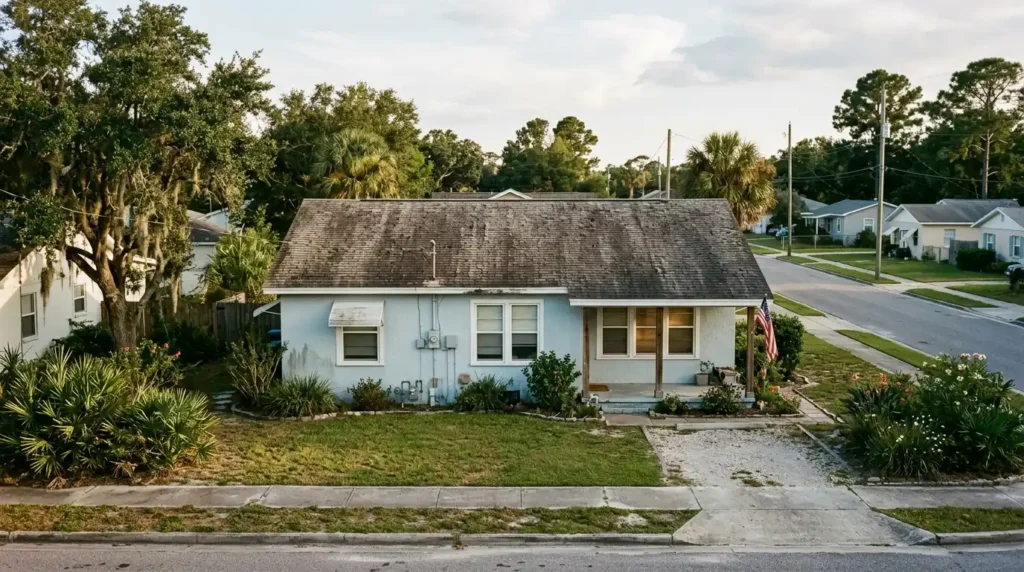
Most Bay County homeowners find out how a hurricane deductible really works at the worst possible moment: after a storm, staring at an adjuster’s estimate that is thousands of dollars smaller than they expected. The reason is that a hurricane deductible is not a flat few hundred dollars like your everyday deductible. It is a percentage of what your home is insured for, and that changes the math completely.
On a typical Panama City, Callaway, or Springfield home, that percentage can mean five figures out of your own pocket before your insurer pays a single dollar. When the damage is real but the deductible is bigger than what you can afford, or bigger than the repair itself, a lot of owners get stuck.
This post walks through exactly how the deductible is calculated, shows the real numbers on a normal home, explains why claims stall, and lays out what owners do when the deductible outruns their budget or their equity.
Key Takeaways
- It is a percentage, not a flat dollar. Florida requires insurers to offer hurricane deductible options of $500, 2 percent, 5 percent, and 10 percent of your dwelling limit.
- The numbers are large. On a home insured for $300,000, that is $6,000 to $30,000 out of pocket before coverage pays anything.
- It applies per calendar year, not per storm. A second hurricane in the same year draws down whatever deductible is left.
- If repairs cost less than the deductible, your insurer pays nothing. You cover the whole repair yourself.
- When the deductible outruns your budget or equity, selling as-is to a cash buyer is often the cleaner exit.
Table of Contents
- What a hurricane deductible actually is
- The real math, with numbers
- Your options when the deductible outruns the repair budget
- How selling to Panhandle Real Estate Investments works
- Panama City, Callaway, and Bay County specifics
- Frequently asked questions
What a Hurricane Deductible Actually Is
Your policy has more than one deductible. There is the standard deductible for everyday claims, and a separate, much larger hurricane deductible that kicks in only when a declared hurricane damages your home. The everyday one is usually a flat dollar amount. The hurricane one is a percentage of your dwelling coverage, which is the figure your home is insured to rebuild for.
That percentage is set by state law, not guesswork. Florida law requires insurers to offer hurricane deductibles of $500, 2 percent, 5 percent, or 10 percent of your dwelling limit. Most Panhandle policies land on the 2 percent option as the practical floor, and coastal or older homes are often pushed to 5 or 10 percent.

The catch is that a percentage of a whole house is a big number. Two percent sounds tiny until you apply it to a $300,000 rebuild cost. That gap between what people expect and what the deductible actually is causes a lot of the stalled, frustrating claims we see, and it is closely tied to selling a house with an open insurance claim that never quite gets resolved.
The Real Math, With Numbers
Here is the part nobody explains until it is too late. Your hurricane deductible is your dwelling limit multiplied by the percentage on your policy. It is the amount you pay first, before your insurer pays anything at all.
Say your home’s dwelling limit is $300,000. A 2 percent hurricane deductible is $6,000. At 5 percent it is $15,000. At 10 percent it is $30,000. Those are your out-of-pocket numbers before a single dollar of coverage arrives. Here is how that scales across common dwelling limits.
| Dwelling limit (rebuild cost) | 2% deductible | 5% deductible | 10% deductible |
|---|---|---|---|
| $200,000 | $4,000 | $10,000 | $20,000 |
| $300,000 | $6,000 | $15,000 | $30,000 |
| $400,000 | $8,000 | $20,000 | $40,000 |
There is one piece of good news in the law. The hurricane deductible applies on a calendar-year basis, not per storm. Under Florida law the hurricane deductible applies once per calendar year to all covered hurricane losses, so a second hurricane in the same year draws down whatever deductible you have left rather than starting a brand new full one. It helps, but the first hit is still the big one.
Now put the two facts together. If a storm does $5,000 of damage to a home with a 2 percent deductible on a $300,000 limit, the deductible is $6,000, so your insurer pays nothing and you pay all of it. That is not a denied claim. That is the deductible working exactly as written, and it is the moment a lot of owners realize the coverage they were counting on will not show up.
Your Options When the Deductible Outruns the Repair Budget
When the deductible is bigger than the repair, or bigger than the cash you have, you have three honest paths.
Pay out of pocket and keep the home. If you have the money and the home is otherwise sound, covering the repair yourself and moving on is perfectly reasonable. The problem is that a percentage deductible can be five figures, and not everyone has that sitting in savings after a storm.
List it on the open market. You can try to sell the traditional way, but storm damage plus an unresolved deductible is a hard sell to a financed buyer, whose lender needs the home insurable and often needs repairs done first. That is the same dynamic behind how we price severely damaged homes that the retail market will not touch.
Sell directly to a cash buyer. A cash buyer does not need the claim resolved or the repairs done to close, so the deductible stops being your problem. If your home is in Bay County you can sell your Springfield house as-is and hand the damage, the deductible, and the paperwork to a buyer built to handle it.
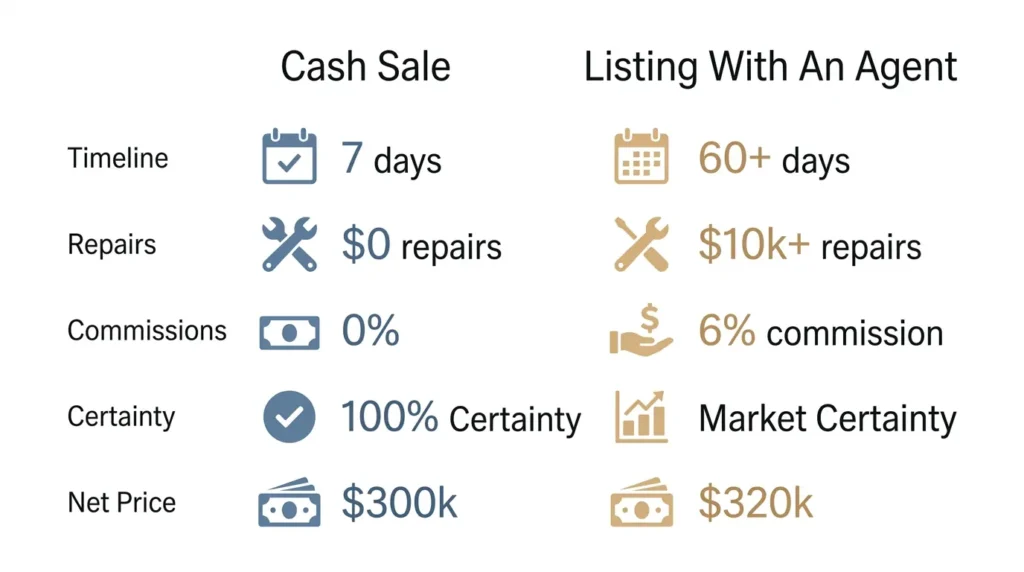
| Factor | Cash Sale (As-Is) | Listing With an Agent |
|---|---|---|
| Timeline | Often within a few weeks | Typically 60 to 120 days or more |
| Storm repairs | None, we buy with the damage | Often required before a financed buyer can close |
| Open claim / deductible | Not your problem to resolve first | Can stall the sale until settled |
| Buyer pool | Cash buyers, damage priced in | Mostly financed buyers whose lender needs a policy |
| Commissions | None | Typically 5 to 6 percent |
| Certainty of close | High | Subject to financing, insurance, inspection, appraisal |
| Net price | Below market, minus no repair bills | Closer to market, before the repairs and costs |
For a side-by-side on the tradeoffs, we keep an honest cash offer versus agent listing comparison that lays it out without the sales spin. The right answer is whichever path nets you the most after the deductible and repairs are accounted for, not whichever headline price looks biggest.
How Selling to Panhandle Real Estate Investments Works
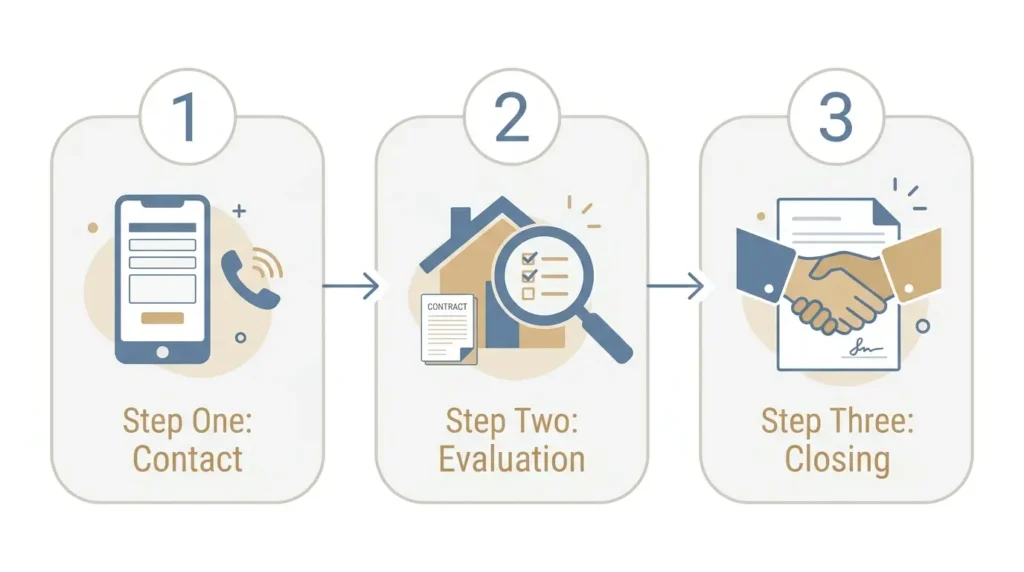
If a cash sale is the right exit, the process is short and there is no obligation to accept anything.
- Request an offer. Tell us about the home, the storm damage, and where the claim stands if there is one. It takes a few minutes and there is no commitment.
- We look at the damage and the numbers. We estimate the repairs and build them into a fair cash offer, with the math shown rather than hidden. An open claim or a big deductible does not scare us off.
- Close on your timeline. If the offer works, we handle the paperwork and close when you are ready, with no repairs to finish and no deductible to cover first.
Not every owner should sell. If the damage is minor and you can absorb the deductible, keeping the home may be the better move, and we will tell you so plainly when it is true for your situation.
Panama City, Callaway, and Bay County Specifics
Bay County learned the hurricane deductible the hard way after Hurricane Michael, when thousands of Panama City, Callaway, and Springfield owners discovered their percentage deductible was far larger than the cash they had on hand. That legacy still shapes the market here, with older roofs, lingering damage, and homes that never fully recovered.
Coastal and older Bay County homes also tend to carry the higher 5 and 10 percent deductibles, which is where the numbers get brutal. This is not happening in a vacuum either, and it fits inside the wider Panhandle insurance picture of rising premiums and shrinking coverage across the region.
It also means local cash buyers already understand these deductibles and these homes. Storm damage with an unaffordable deductible on a Panama City or Callaway property is routine to an investor, not a dealbreaker. If the deductible math is what is pushing you to sell, that is the part of the market that stays open to you.
Frequently Asked Questions
How is the Florida hurricane deductible calculated?
It is a percentage of your dwelling coverage, not a flat dollar amount. Florida law requires insurers to offer hurricane deductible options of $500, 2 percent, 5 percent, and 10 percent of your policy’s dwelling limit. So on a home insured for $300,000, a 2 percent deductible is $6,000 that you pay before coverage kicks in.
Is the hurricane deductible per storm or per year in Florida?
It applies on a calendar-year basis, not per storm. Under Florida law the hurricane deductible applies annually to all covered hurricane losses in that calendar year, so a second hurricane in the same year draws down whatever deductible is left rather than starting a fresh full one. That is better than per-storm, but the first hit is still large.
What is the difference between a hurricane and a windstorm deductible?
A hurricane deductible applies only to damage from a declared hurricane, while a windstorm deductible applies to wind damage from any storm. Hurricane deductibles are usually a percentage of your dwelling limit, so they run much higher than a standard flat deductible. Which one applies depends on your policy and what triggered the claim.
Can I lower my hurricane deductible?
Sometimes, by choosing a lower percentage or the $500 option, but that raises your premium and not every home qualifies for the lowest tiers. Insurers price the risk, so a coastal or older home may be limited to higher deductibles. Lowering it trades a bigger yearly premium for a smaller out-of-pocket hit if a storm hits.
What if the repair cost is less than my deductible?
Then your insurer pays nothing and you cover the full repair yourself. On a percentage deductible this happens more than people expect, because $6,000 to $15,000 of damage can fall entirely under the deductible. When the deductible swallows the repair, or exceeds what you can afford, selling as-is is often the cleaner move.
A hurricane deductible does not have to trap you. Whether you absorb it and keep the home, or decide the math is your signal to sell, the right move comes down to your numbers, and knowing the as-is value is the fastest way to see them clearly.
If you want to know what your Panama City, Callaway, or Springfield home is worth as-is, storm damage and deductible included, we are happy to give you a straightforward answer. No obligation, no pressure. Request a cash offer from Panhandle Real Estate Investments.

About Panhandle Real Estate Investments
I’m Peyton Saluto, founder of Panhandle Real Estate Investments. For over seven years, I’ve helped homeowners across the Florida Panhandle find fair and stress-free ways to sell their homes—no repairs, no commissions, and no pressure. My goal is always to put people first and make a real difference in our communities by restoring distressed properties and rebuilding neighborhoods. If you’re thinking about selling, reach out for a no-obligation cash offer. I’d love the opportunity to help you find the best path forward.