
Published by Panhandle Real Estate Investments, a locally owned real estate solutions company serving Escambia County, Santa Rosa County, Okaloosa County, and Bay County. We buy houses and land across the Florida Panhandle.
Last Updated: October 15, 2026
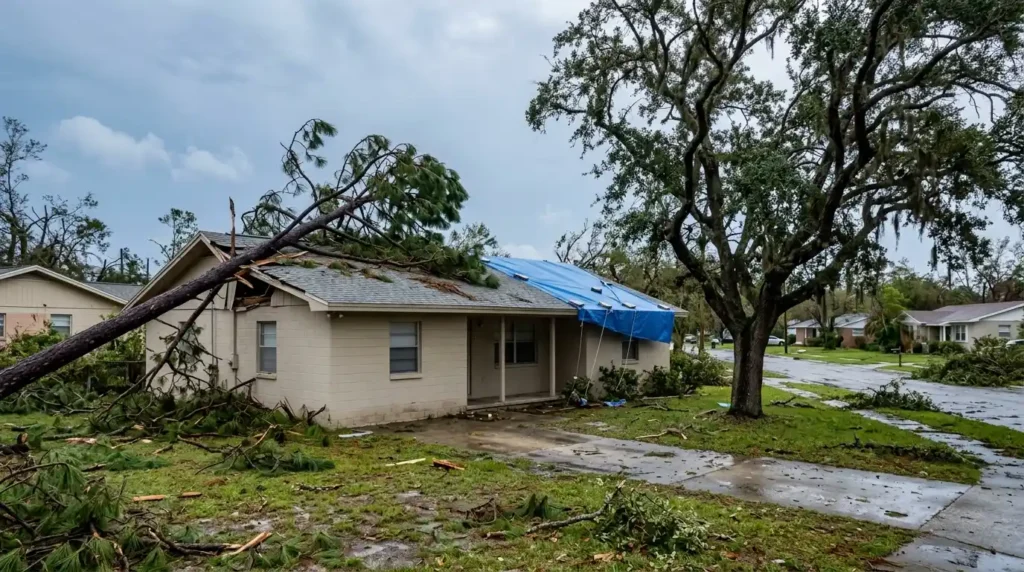
Hurricane Isaias brought down pines and live oaks all over Pensacola, Gulf Breeze, Milton, and Navarre, and a lot of them landed on houses. If one landed on yours, you probably have three questions at once: is it safe to go inside, who is going to pay for this, and how do you get a tree off a roof.
The good news is that the rules here are clearer than most storm questions. Your own homeowners policy is usually the one that pays for your house, even if the tree was your neighbor’s. The harder parts are the deductible, the cost of getting the tree removed, and finding a crew you can trust while every tree service in the state is in town.
This guide walks through the first hours, who pays for what, how removal and debris actually work in Escambia and Santa Rosa counties, and what your options are if the damage turns out to be bigger than a tree.
Key Takeaways
- Safety first. Stay out of rooms under the tree and treat every downed power line as live.
- Your policy pays for your house, no matter whose tree it was. Your insurer may try to recover the cost from the neighbor’s insurer later.
- A tree that fell during Isaias usually falls under your hurricane deductible, not your everyday one.
- Removal coverage is limited. It is generally a few hundred to about a thousand dollars when the tree hits your house, and usually nothing when it hits nothing.
- You can remove a dangerous tree without a local permit if a certified arborist documents the risk.
Table of Contents
- What to do in the first hours
- Who pays when a tree hits your house
- Getting the tree off and hauled away
- Your options when the damage is bigger than a tree
- How selling to Panhandle Real Estate Investments works
- Pensacola, Gulf Breeze, Milton, and Navarre specifics
- Frequently asked questions
What to Do in the First Hours
Do these in order. None of them requires you to have decided anything about repairs, claims, or selling yet.
Tree on the house: a first-hours checklist
- Get everyone out of the rooms under or near the tree. A tree can keep shifting, and a damaged roof can drop more debris without warning.
- Stay away from power lines. UF/IFAS advises homeowners to assume all power lines are energized and not to touch them, and to call the power company about limbs on a line. Report it to FPL or your electric cooperative.
- Photograph and video everything before anything moves. Get the tree, the roof, the inside damage, and the stump if you can. Your claim depends on it.
- Call your insurer and report the claim. Ask what they allow for emergency tarping and tree removal before you hire anyone.
- Protect the house from more damage. A tarp over the hole and towels on the floor count. Most policies expect reasonable steps like these, and the costs are often reimbursable.
- Keep every receipt, from the tarp to the hotel room.
Those steps are the same ones that apply to any storm damage, and we lay out the whole sequence in our guide to whether you should repair, file a claim, or sell after a storm.
Who Pays When a Tree Hits Your House
Start with the rule that surprises most people. According to the Insurance Information Institute, you are insured no matter who owns the tree. If a neighbor’s tree lands on your house, you file with your own insurer, and your insurer may later try to collect from the neighbor’s insurer. If that works, you may get your deductible back.
The deductible is the second surprise. Florida law defines the hurricane period as beginning when a hurricane warning is issued for any part of Florida and ending 72 hours after the last hurricane watch or warning ends. A tree that came down during Isaias falls inside that window, so the hurricane deductible usually applies. That is often a percentage of your dwelling coverage, and it can be large, so it helps to understand how the hurricane deductible works before you count on a check.
Who usually pays, by situation
| What happened | Who usually pays |
|---|---|
| Your tree hit your house | Your homeowners policy, minus your deductible |
| Your neighbor’s tree hit your house | Your homeowners policy first, and your insurer may pursue the neighbor’s insurer |
| Your tree hit your neighbor’s house | Usually your neighbor’s own policy |
| A tree fell and hit nothing | Usually you, because there is generally no coverage for removal |
| A tree is blocking your driveway | Sometimes covered for removal, depending on your policy |
One caution: every policy is worded a little differently. Your declarations page and your adjuster have the final word, so treat this table as the general pattern, not a promise for your policy.
Getting the Tree Off and Hauled Away
Removal is where the money gets tight. When a tree hits an insured structure, the Insurance Information Institute says a homeowners policy generally covers removal up to about 500 to 1,000 dollars, depending on the insurer and the policy. A large tree on a roof can cost well beyond that to remove, so get the estimate in writing before work starts.
Hire carefully. UF/IFAS recommends asking for proof of insurance and whether the person is an ISA certified arborist, especially when the tree is near people or property. Crews from all over the country come in after a hurricane, and most are honest, but the ones who show up first are not always the ones you want. The same rules from our guide to vetting any contractor before you pay apply here: written estimate, proof of insurance, and no large cash payment up front.
If cost is the problem, there is free help. In Escambia and Santa Rosa counties, the Crisis Cleanup hotline at 1-800-451-1954 connects residents with volunteer groups that may help with tree removal, debris cleanup, and roof tarping. The help is free, but a request does not guarantee service.
Two rules save headaches with the county:
- Debris goes at the roadside, sorted. Escambia County asks residents to separate tree debris from construction debris and not to bag it, and Santa Rosa uses the same sorting rules.
- If you pay a contractor, the contractor hauls it. Santa Rosa County says that when you hire a contractor to cut or remove fallen trees, the contractor is responsible for hauling the debris away, and it should not go on the right-of-way for county pickup.
And if a damaged tree is still standing and threatening the house, Florida law helps. Under section 163.045 of the Florida Statutes, a local government may not require a permit, fee, or replanting for removing a tree on residential property when an ISA certified arborist or a Florida licensed landscape architect documents that it poses an unacceptable risk to people or property.
Your Options When the Damage Is Bigger Than a Tree
Sometimes the tree is the easy part. It punched through the roof, the rain followed, and now the ceiling, insulation, and floors are wet too. Once the damage spreads like that, you have three honest paths.
Repair through the claim and stay. If the claim covers most of the work and you want to keep the house, this is usually the right call. Budget for the hurricane deductible and the removal costs the policy will not cover.
Repair, then sell. A fully repaired house reaches the whole retail market. The tradeoff is months of carrying costs and contractor management while the work gets done.
Sell as-is. If the deductible, the removal bill, and the water damage add up to more than you want to take on, a cash buyer can take the house in its current state, and in most cases you keep your claim rights in writing. You can sell your Pensacola house as-is or sell your Gulf Breeze house as-is without fixing the roof first.
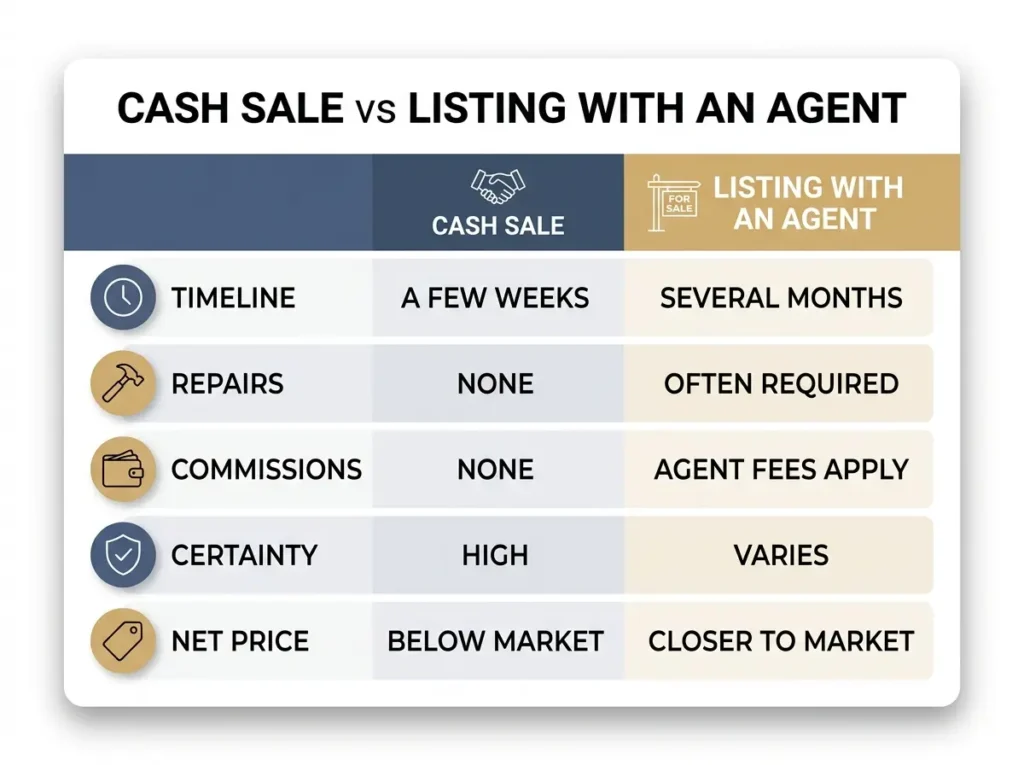
| Factor | Cash Sale (As-Is) | Listing With an Agent |
|---|---|---|
| Timeline | Often within a few weeks | Typically 60 to 120 days or more |
| Roof and storm repairs | None, we buy as-is | Usually needed before a financed buyer can close |
| Open insurance claim | You can keep the claim rights | Has to be sorted out and disclosed for the buyer |
| Commissions | None | Typically 5 to 6 percent |
| Certainty of close | High | Subject to financing, inspection, appraisal |
| Net price | Below market, no repairs or fees | Closer to market, after repairs and costs |
For a side-by-side on the tradeoffs, we keep an honest cash offer versus agent listing comparison that lays it out without the sales spin. If the tree only clipped a gutter and the claim covers the rest, repairing is the better move, and we would tell you so.
How Selling to Panhandle Real Estate Investments Works
If selling as-is turns out to be the right fit, the process is short and there is no obligation to accept anything.
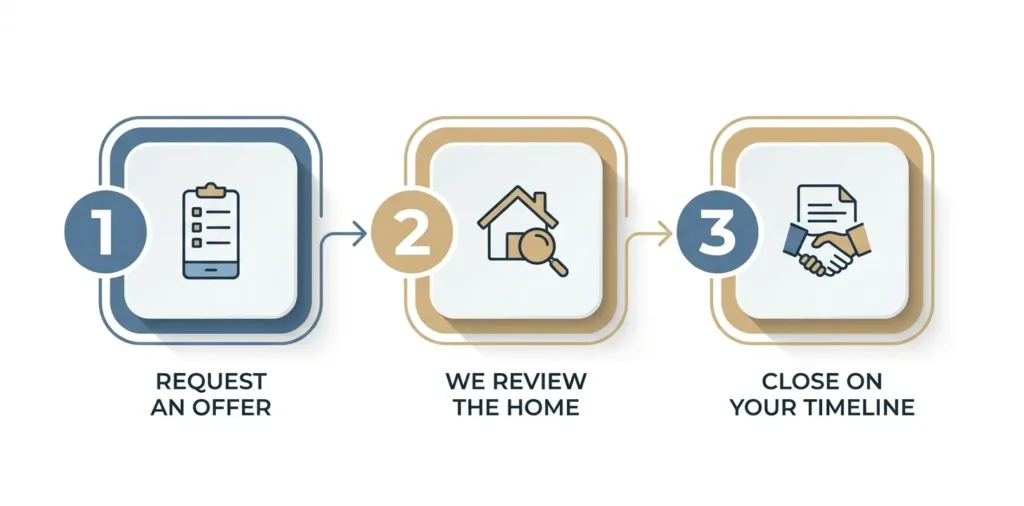
- Request an offer. Tell us about the house, the tree damage, and where your claim stands. It takes a few minutes and there is no commitment.
- We look at the damage and the numbers. We estimate the roof, water, and removal work and build it into a fair cash offer, with the math shown rather than hidden.
- Close on your timeline. If the offer works, we handle the paperwork, your claim rights stay with you in writing if you want them, and you close when you are ready.
Most tree damage gets repaired, not sold, and that is how it should be. If yours is the exception, we are here when you want the numbers.
Pensacola, Gulf Breeze, Milton, and Navarre Specifics
Hurricane Isaias made landfall near Destin around 8:30 p.m. on October 9 with maximum sustained winds of 105 mph, and its winds reached across Escambia and Santa Rosa counties. These are older, tree-lined neighborhoods, from the live oaks of East Hill and North Hill in Pensacola to the tall pines around Milton and Pace, and big old trees near houses are exactly what fails in a storm like this.
That also means local tree crews and adjusters are stretched thin right now. Expect delays, keep your tarp in good shape, and do not let the wait push you into signing with the first crew that knocks. If someone quotes a price that seems wildly out of line, report it to the Attorney General’s price gouging hotline at 1-866-9-NO-SCAM.
Many cities in these counties also have their own tree rules. For a dangerous tree, the state arborist rule above overrides a local permit requirement, but for healthy trees you plan to remove later, check with your city first.
Frequently Asked Questions
Does homeowners insurance cover a tree falling on my house in Florida?
Usually, yes. A standard homeowners policy covers damage to your house from a tree knocked down by wind, which includes a hurricane. During a hurricane, the hurricane deductible usually applies instead of your everyday deductible. Coverage details vary by policy, so check your declarations page and report the claim as soon as it is safe.
Who pays if my neighbor’s tree falls on my house?
Your own insurer pays for the damage to your house, no matter who owned the tree. You file with your company, and it may later try to recover the cost from your neighbor’s insurer. If that works, you may get your deductible back. Your neighbor does not have to file anything for you to get your house repaired.
Does insurance pay to remove a fallen tree?
Usually only when the tree hits an insured structure, and then generally up to about 500 to 1,000 dollars, depending on the policy. If the tree fell and hit nothing, removal is usually not covered, though some insurers pay when it blocks a driveway. Large trees can cost more than the limit, so get a written estimate first.
Do I need a permit to remove a damaged tree in Florida?
Not for a dangerous one. Florida law says a local government may not require a permit, fee, or replanting to remove a tree on residential property when an ISA certified arborist or a Florida licensed landscape architect documents that it poses an unacceptable risk. For healthy trees, check your city or county rules first.
Can I sell my house with tree damage?
Yes. You have to disclose the damage, and financed buyers often need the roof fixed before their lender will close. A cash buyer can take the house as-is, and in most cases you keep your insurance claim rights in writing. For minor damage the claim covers, repairing first usually nets you more.
A tree on the house feels like a disaster the first night, but most of the time it is a repair, a claim, and a few hard weeks. Take it one step at a time, keep your paperwork, and make the bigger decisions once you know what the claim and the estimates actually say.
If the damage turns out to be more than you want to take on and you want to know what your Pensacola, Gulf Breeze, Milton, or Navarre house is worth as-is, we are happy to give you a straightforward answer. No obligation, no pressure. Request a cash offer from Panhandle Real Estate Investments.

About Panhandle Real Estate Investments
I’m Peyton Saluto, founder of Panhandle Real Estate Investments. For over seven years, I’ve helped homeowners across the Florida Panhandle find fair and stress-free ways to sell their homes—no repairs, no commissions, and no pressure. My goal is always to put people first and make a real difference in our communities by restoring distressed properties and rebuilding neighborhoods. If you’re thinking about selling, reach out for a no-obligation cash offer. I’d love the opportunity to help you find the best path forward.