
Published by Panhandle Real Estate Investments, a locally owned real estate solutions company serving Bay County, Escambia County, Okaloosa County, and Santa Rosa County. We buy houses and land across the Florida Panhandle.
Last Updated: November 26, 2026
In Florida, a court judgment recorded in a county’s official records becomes a lien on real property there for an initial 10 years, and it can be extended up to a 20-year limit. A contractor who was not paid has 90 days after its final work to record a claim of lien. Unpaid property taxes sit ahead of all of them, because Florida makes taxes a first lien, superior to all other liens.
So when an owner in Panama City, Pensacola, or Fort Walton Beach decides to sell, the title search often turns up more than the mortgage. Most liens do not block a sale. They get paid from the proceeds, released, or moved off the property, and each type has its own rules for how that happens.
This guide sorts the common liens one by one: where each comes from, how long it lasts, whether it can touch a homestead, and how it is cleared. It also covers what to do when the liens add up to more than the house is worth.
Key Takeaways
- Most liens are paid at closing. The title company gets a written payoff from each lienholder and pays it from your proceeds.
- Property taxes come first. Florida law puts the tax lien ahead of every other lien.
- A judgment cannot be a lien on your homestead. Florida’s constitution protects it, and a recorded Notice of Homestead can clear the title for a sale.
- IRS liens need their own paperwork. The IRS can discharge its lien from the house being sold, and it asks for the application at least 45 days ahead.
- If the liens exceed the price, someone has to agree to take less. That can mean a short sale, a negotiated payoff, or an IRS discharge.
Table of Contents
- How a lien affects a sale
- Common liens and how each one is cleared
- Judgment liens and your homestead
- IRS tax liens: asking for a discharge
- Contractor liens under Chapter 713
- How to find every lien on your property
- When the liens add up to more than the house
- Your options, side by side
- Frequently asked questions
How a Lien Affects a Sale
A lien is a recorded claim against property that secures a debt. It stays with the property until it is paid, released, or expires, so a buyer and the buyer’s title insurer will not accept the deed until each one is handled.
In practice, that work happens inside the closing. The title company searches the county records, orders a payoff from each lienholder, lists every amount on the seller side of the settlement statement, and pays each one from the sale money. Our post on how cash buyers close with liens, heirs, or title problems walks through that workflow.

Two lienholders have a legal deadline to give you a number. A mortgage servicer must send an estoppel letter with the payoff within 10 days of a written request, and must send the release for recording within 60 days after the loan is paid. A homeowners association must issue an estoppel certificate within 10 business days.
Common Liens and How Each One Is Cleared
Each lien type has its own clock and its own way out.
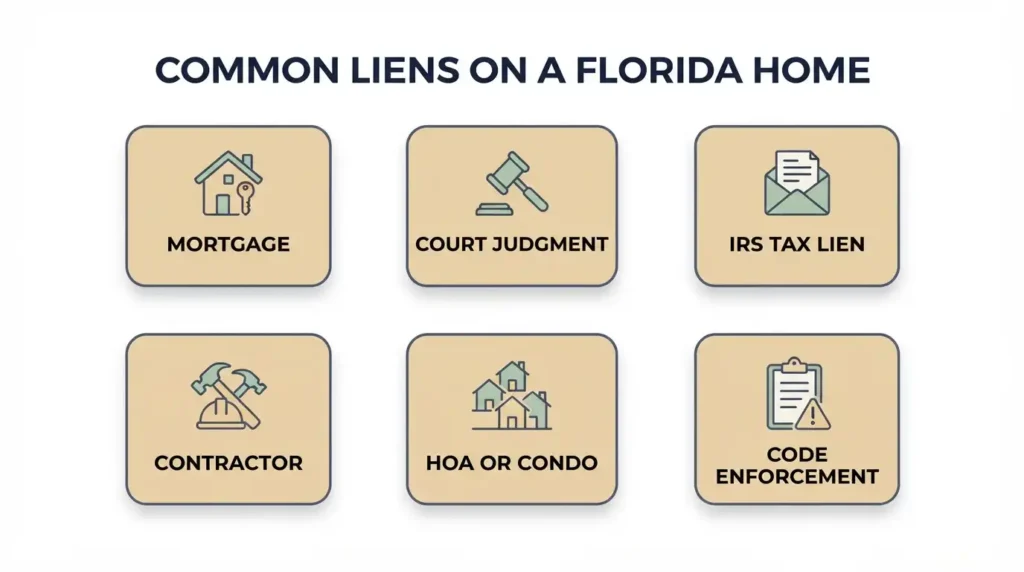
| Lien | Where it comes from | How long it lasts | How it is usually cleared |
|---|---|---|---|
| Mortgage | Your home loan | Until paid and released | Payoff letter, paid at closing, release recorded |
| Property taxes | The county tax collector | Until paid, and first in line | Paid at closing, or redeemed if a tax certificate was sold |
| Court judgment | A creditor who won a lawsuit | 10 years, can be extended up to 20 | Payoff, a negotiated satisfaction, or a Notice of Homestead on a homestead |
| IRS federal tax lien | Unpaid federal taxes | Until the debt is paid and the IRS releases it | Payoff, or a certificate of discharge |
| Contractor lien | An unpaid contractor, subcontractor, or supplier | 1 year unless the lienor sues | Payoff, release, notice of contest, or transfer to a bond |
| HOA or condo lien | Unpaid association assessments | Until paid | Estoppel certificate, paid at closing |
| Code enforcement lien | A city or county fine order | Up to 20 years | Payoff, or a reduction request first |
Code liens deserve their own look, because the fine can keep growing every day. Our guide to reducing or settling a code enforcement lien in Escambia County covers how to ask for relief, and our Bay County post shows how a cash sale clears code violations and liens in Panama City.
HOA and condo balances follow the same estoppel and payoff path. A buyer who takes title is jointly liable for assessments that came due before the transfer, which is why no title company skips that step.
Judgment Liens and Your Homestead
A creditor who wins a lawsuit can record a certified copy of the judgment in any county where you own property, and it becomes a lien there. Under section 55.10, the recorded judgment must show the creditor’s address, and the lien can be extended by re-recording it before it runs out.
Your homestead gets special protection. Florida’s constitution, in Article X, Section 4, says no judgment shall be a lien on a homestead, with exceptions for property taxes, the loan used to buy or improve it, and debts for work done on it. A rental, a second home, or an inherited house you do not live in has no such protection.
The catch is that the judgment still shows up in the title search, even on a homestead. Florida’s fix is the Notice of Homestead. Once you have a contract to sell, you can record the notice and send it to the judgment creditor, who then has 45 days to file suit. If the creditor does nothing, the buyer takes the property free of that judgment lien.
For a judgment on property that is not your homestead, the usual paths are paying it from the proceeds or negotiating a lower satisfaction with the creditor. Section 55.10 also lets an owner move the lien to a cash deposit or bond with the clerk, which releases the property.
IRS Tax Liens: Asking for a Discharge
A federal tax lien works differently. The IRS says its lien attaches to all of your assets, including real estate and property you acquire later. Plan on dealing with it before closing, even on the house you live in.
If the sale pays the tax debt in full, the title company pays the IRS, and the IRS releases the lien within 30 days of payment. If the sale will not cover it, you can apply for a certificate of discharge, which removes the lien from the one property being sold. IRS Publication 783 explains the options and asks for the application at least 45 days before the closing date.
One option matters when the house is underwater. Publication 783 says the IRS can discharge its lien when its interest has no value, meaning the debts ahead of it are larger than the property’s value or sale price. A tax professional or Florida attorney can help with the application.
Contractor Liens Under Chapter 713
Florida’s Construction Lien Law lets a contractor, subcontractor, or supplier record a claim of lien when it is not paid, even if you paid your main contractor. Under section 713.08, the claim must be recorded within 90 days after that lienor’s final work or materials.
These liens do not last forever. Under section 713.22, a construction lien ends one year after it is recorded unless the lienor files suit to enforce it. An owner can shorten that window by recording a Notice of Contest of Lien, which gives the lienor 60 days to sue or lose the lien.
If you need to close before the dispute is settled, section 713.24 lets you transfer the lien to a cash deposit or surety bond with the clerk, which releases the property. Other ways out are a signed release from the lienor or a court order canceling the lien. If you are paying for Hurricane Isaias repairs, collect a lien release from every roofer and subcontractor before the final payment.
How to Find Every Lien on Your Property
Do not wait for the buyer’s title search to learn what is recorded. Recorded liens are public records kept by the Clerk of Court in each county.
Five checks before you set a price
- Search the county official records. The Bay County Clerk’s official records search covers final judgments, land records, and other documents recorded since January 1, 1987. The clerks in Okaloosa, Santa Rosa, and Escambia County keep the same records. Search your name and the names of past owners.
- Ask for written payoffs. Request an estoppel letter from your mortgage servicer and an estoppel certificate from any HOA or condo association.
- Check the property taxes. Look up the parcel with your county tax collector to see whether taxes are unpaid or a tax certificate was sold.
- Ask about code cases and utility balances. Some city charges never appear in the recorded records, so title companies run a separate municipal lien search.
- Flag anything that is not yours. A judgment against someone with a similar name, or a paid mortgage that was never released, can often be cleared with the right paperwork.
When the Liens Add Up to More Than the House
This is the hard case, and we will be straight about it. A buyer pays one price. If the liens are bigger than that price minus closing costs, the sale cannot close unless a lienholder agrees to take less or you bring money to closing.
- Short sale. Your mortgage lender agrees to accept less than it is owed. It takes the lender’s approval, paperwork, and time.
- Negotiated payoffs. Judgment creditors, contractors, and collection firms sometimes accept less in exchange for being paid now. Nothing requires them to.
- IRS no-value discharge. If the debts ahead of the IRS lien already exceed the value, the IRS may discharge its lien, as described above.
- Code lien reduction. Cities and counties can reduce code fines, and Escambia County has a written process.
- Advice first. With several creditors, a Florida real estate attorney can tell you which path fits.
A cash buyer cannot make an underwater house come out even. What we can do is give you a real number early, so you know the size of the gap before you start talking to lienholders. Our older post on selling a property with a lien in Destin covers the basics for Okaloosa County owners.
Your Options, Side by Side
When the liens fit inside the price, the question becomes how to sell.
| Sell as-is for cash | List with an agent | |
|---|---|---|
| Liens | Paid from proceeds at closing | Paid from proceeds at closing |
| Repairs | None required | Often needed to pass the buyer’s inspection and appraisal |
| Timeline | Often a few weeks, depending on the title work | Depends on showings, offers, and the buyer’s loan |
| Commissions | None | Agent commission applies |
| Price | Below full market value | Closer to full market value |
| Best fit | Heavy liens, a house that needs work, or a tight deadline | A house in good shape with room left after the liens |
If your house is in good shape and the liens leave plenty of room, listing will often net more, and we will tell you that. Our cash offer versus agent listing comparison lays out the tradeoffs.
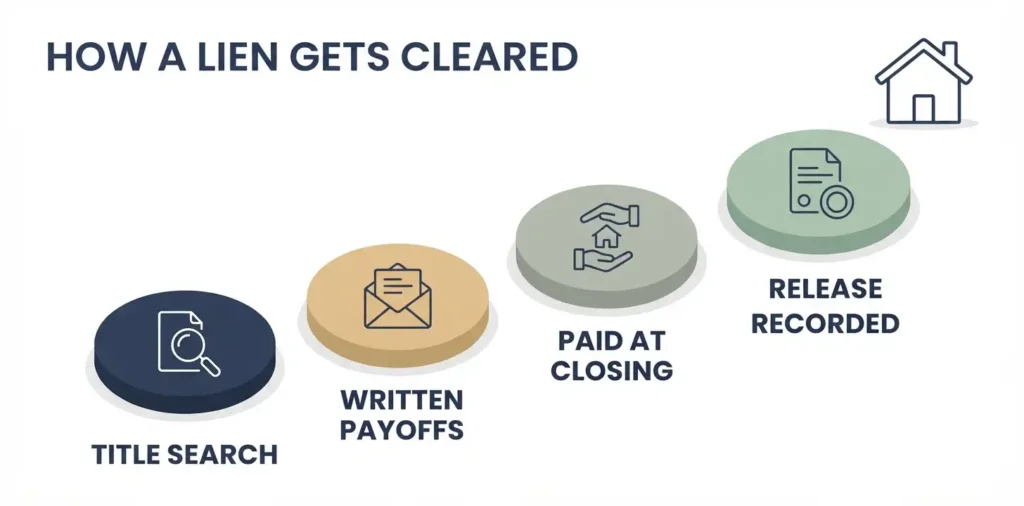
How a sale with us works
- Tell us about the house and the liens. Share what you know, even if it is only a letter or a court notice. There is no obligation.
- We order the title work. We see every recorded lien, request the payoffs, and make a fair cash offer with the math shown.
- Close when it works for you. The title company pays each lienholder at closing, and you receive what is left.
Read more about how our purchase process works.
Frequently Asked Questions
Can you sell a house with a lien on it in Florida?
Yes. Most liens are paid from the seller’s proceeds at closing, and the buyer gets clear title once each lienholder is paid and the release is recorded. The title company finds the liens, orders written payoffs, and pays them directly. Trouble starts only when the liens exceed the price or a lienholder disputes the amount owed.
Who pays off the lien at closing?
Usually the seller. Liens on the property are the seller’s debts, so the payoffs come out of the seller’s proceeds on the settlement statement before the seller receives the rest. A contract can shift some costs, and in an as-is cash sale the buyer’s offer already accounts for the known liens. Get every payoff in writing first.
What happens if the liens exceed the sale price?
The sale cannot close unless a lienholder agrees to take less or the seller brings money to closing. Options include a short sale with the mortgage lender’s approval, negotiated payoffs with judgment creditors or contractors, an IRS discharge when its lien has no value, and code fine reductions. A Florida attorney can help you choose the right path.
How do I find out what liens are on my Florida property?
Search the official records at your county Clerk of Court under your name and past owners’ names, and check the tax collector for unpaid taxes. Ask your mortgage servicer for an estoppel letter and your HOA for an estoppel certificate. A title search from a title company will also catch liens and municipal charges you might miss.
Can a lien be removed or negotiated down?
Often, yes, depending on the type. Judgment creditors and contractors may accept less, code liens can be reduced by the local government, and the IRS can discharge its lien from a property being sold. A construction lien ends after one year unless enforced, and a homestead owner can use a Notice of Homestead against a judgment lien.
A lien makes a Florida sale more complicated, but it does not have to stop one. Find out exactly what is recorded, get every payoff in writing, and match each lien to the right fix before you agree to a price.

If you have a house in Panama City, Pensacola, or Fort Walton Beach with liens attached and want a straight answer on what it is worth as-is, we are happy to look at it with you. No obligation, no pressure. Request a cash offer from Panhandle Real Estate Investments.

About Panhandle Real Estate Investments
I’m Peyton Saluto, founder of Panhandle Real Estate Investments. For over seven years, I’ve helped homeowners across the Florida Panhandle find fair and stress-free ways to sell their homes—no repairs, no commissions, and no pressure. My goal is always to put people first and make a real difference in our communities by restoring distressed properties and rebuilding neighborhoods.
If you’re thinking about selling, reach out for a no-obligation cash offer. I’d love the opportunity to help you find the best path forward.