
Published by Panhandle Real Estate Investments, a locally owned real estate solutions company serving Bay, Okaloosa, Santa Rosa, Escambia, and Walton Counties. We buy houses, condos, and land across the Florida Panhandle.
Last Updated: August 20, 2026
On this page
- What a failed milestone inspection actually means
- Milestone inspection versus SIRS
- What you have to tell a buyer
- Your four real options
- How selling to Panhandle Real Estate Investments works
- What this looks like in Bay, Escambia, and Santa Rosa Counties
- Frequently asked questions
Once a phase two milestone inspection report identifies substantial structural deterioration in a Florida condominium, repairs must be commenced within 365 days after the association receives that report. If the owners cannot show the local building department that repairs have been scheduled or started, the same statute requires that department to review whether the building is safe for people to live in.
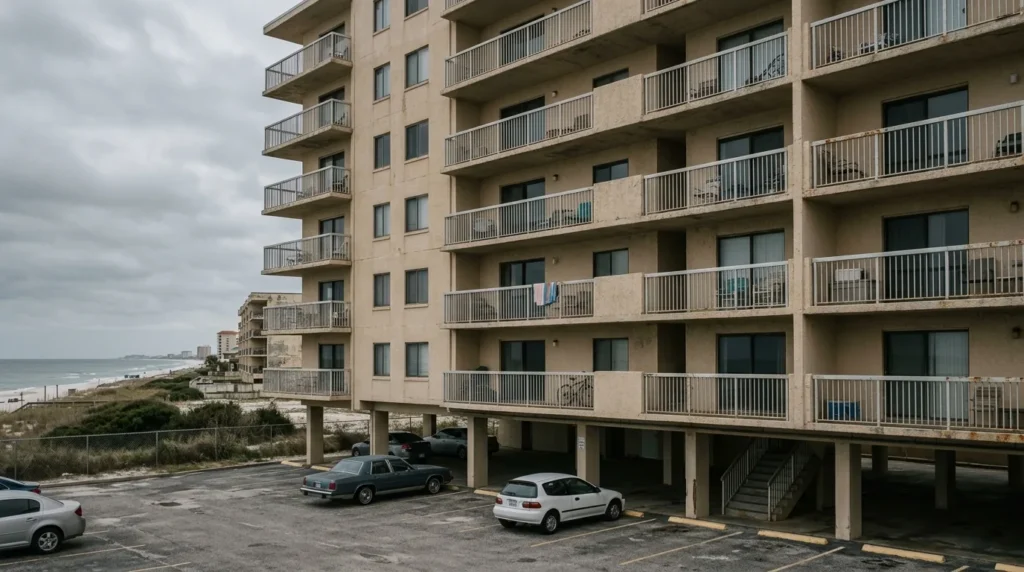
That is the clock running behind every “our building failed its inspection” phone call we take from Panama City Beach, Navarre Beach, and Perdido Key. The engineer’s report is not the emergency by itself. The emergency is what follows it: an assessment nobody budgeted for, a buyer pool that shrinks to people paying cash, and a deadline set by the state rather than by your board.
This post covers what a failed inspection legally means, the difference between a milestone inspection and a structural integrity reserve study, exactly what Florida requires you to hand a buyer, and the four real paths out. Including the two that do not involve selling to us.
Key Takeaways
- A failed phase one is not a condemnation. It means substantial structural deterioration was found and a phase two inspection follows.
- Florida law sets the deadlines, not your board: 45 days to get the summary to every unit owner, 365 days to commence repairs after a phase two report.
- A milestone inspection and a structural integrity reserve study are two different reports with two different jobs. Buyers and lenders read both.
- You can still legally sell. Florida requires you to give the buyer the inspector-prepared summary and the most recent reserve study.
- Financing, not the law, is what usually kills these sales. Cash buyers are unaffected by a lender’s project review.
What a Failed Milestone Inspection Actually Means
Florida requires a milestone inspection on any building of three habitable stories or more that is under condominium or cooperative ownership, by December 31 of the year the building turns 30, and every 10 years after that. The local enforcement agency can move that to 25 years where local conditions such as proximity to salt water justify it, which is exactly the situation for beachfront buildings in Bay, Escambia, and Santa Rosa Counties.
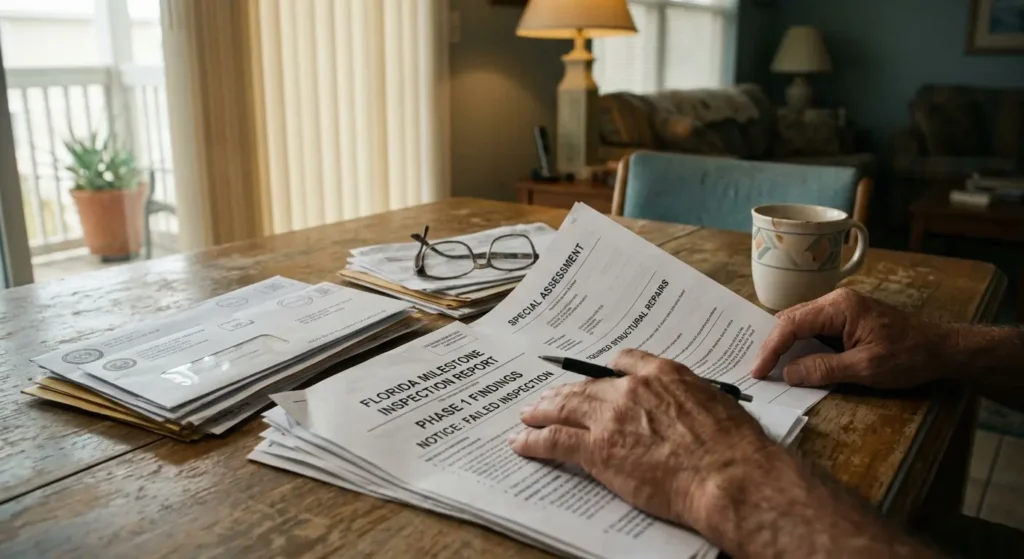
“Failed” is not a term the statute uses. What happens is narrower and more specific than the word suggests. A licensed architect or engineer performs a visual phase one examination. If they find no signs of substantial structural deterioration, the building is done for another 10 years. If they do find it, phase two follows.
Phase one versus phase two
Phase two is the inspection most owners mean when they say the building failed. It can involve destructive or nondestructive testing, opening up concrete and structural members to see how far the damage runs, and the inspector is directed to recommend a repair program.
Surface problems do not automatically count. Cracks, sagging, misalignment, staining, and peeling paint are excluded from the definition of substantial structural deterioration unless the engineer determines they are a symptom of something structural underneath.
The timeline Florida law sets
- The local enforcement agency notifies the association in writing by certified mail. The association has 14 days to notify unit owners and give them the completion date.
- Phase one must be completed within 180 days after that written notice reaches the building’s owners.
- If substantial structural deterioration is found, the inspector performing phase two must submit a progress report with a completion timeline within 180 days after the phase one report.
- Within 45 days of receiving either report, the association must mail or deliver the inspector-prepared summary to every unit owner, post it conspicuously on the property, and publish the full report on its website if it is required to have one.
- Repairs must be commenced within 365 days after the phase two report. Miss that, and the local enforcement agency must determine whether the building is unsafe for human occupancy.
Step five is where the money conversation starts, and it is rarely a small one. We covered how condo assessments escalate once repairs are ordered in a separate guide, because the assessment is usually the part that decides whether an owner stays or sells.
Milestone Inspection Versus SIRS: Two Different Reports
Owners mix these up constantly, and it matters because a buyer’s attorney will not.
A milestone inspection asks whether the building is safe. A structural integrity reserve study, or SIRS, asks whether the association has the money to keep it that way. Florida requires a SIRS at least every 10 years for the same class of building, covering the roof, load-bearing structure, fireproofing and fire protection, plumbing, electrical, waterproofing and exterior painting, windows and exterior doors, plus any other item with a deferred maintenance or replacement cost above $25,000 that affects those systems.
Two changes in the funding rules are why 2026 feels different from 2022 to owners in Panama City Beach and Navarre Beach. For any budget adopted on or after December 31, 2024, the members of an association that must obtain a SIRS can no longer vote to provide no reserves or reduced reserves for those structural items. And those reserves may now be funded by regular assessments, special assessments, lines of credit, or loans, which is why some boards are taking out financing instead of issuing one enormous per-unit bill.
There is also a pressure valve worth asking your board about. For budgets adopted on or before December 31, 2028, an association that completed a milestone inspection within the previous two calendar years may vote to temporarily pause or reduce reserve contributions for no more than two consecutive budget years, specifically to fund the repairs the milestone inspection recommended.
If a special assessment has already landed on your unit rather than looming, the decision narrows further, and we walked through selling a condo with a pending special assessment for owners weighing that exact bill.
What You Have to Tell a Buyer
You do not get to sell a unit in a building with a failed inspection quietly. Florida’s nondeveloper resale disclosure requirements entitle your buyer, at your expense, to a current copy of all of the following:
- The declaration of condominium, articles of incorporation, and the bylaws and rules
- The association’s annual financial statement and annual budget
- The inspector-prepared summary of the milestone inspection report, if applicable
- The association’s most recent structural integrity reserve study, or a statement that one has not been completed
- The turnover inspection report, for turnovers performed on or after July 1, 2023
- The Frequently Asked Questions and Answers document the association is required to maintain
The resale contract itself must carry a conspicuous clause confirming the buyer received the core documents more than 7 business days before signing, or giving the buyer a window to void the contract after receiving them.
Trying to work around this is a bad trade. A buyer told up front either walks early or prices it in, and both beat a sale that collapses at week six with a lawsuit attached.
Your Four Real Options
1. Pay the assessment and keep the unit
If you can cover your share and you intend to stay, this is often the best financial outcome. Repaired buildings with a funded reserve study are the easier ones to sell later. Ask your board whether they are pursuing a line of credit or a loan, which can spread the cost over years instead of quarters.
2. List with a real estate agent
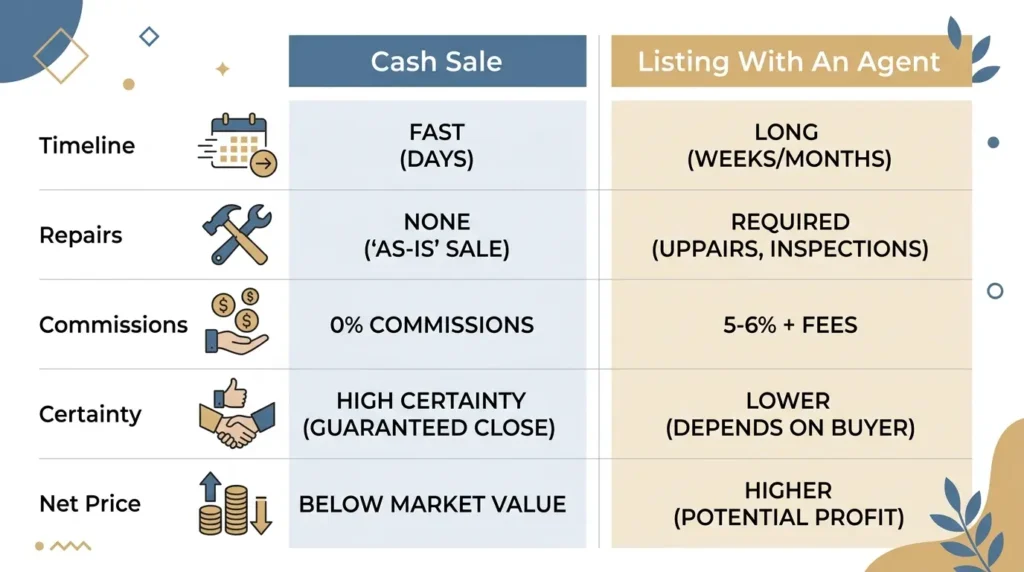
Worth trying if the repair scope is defined, funded, and modest, and your unit shows well. The obstacle is not your unit. Lenders review the condo project itself, not just the borrower, and a building with an open phase two report and no funded repair plan narrows your buyer pool to people who do not need financing. That is a smaller pool at any price. You can compare selling directly against listing with an agent before you commit to either path.
3. Sell as-is to a cash buyer
This is the option that exists precisely because financing dries up. A cash buyer takes the building’s condition as a known fact rather than a surprise, which is the whole point of an as-is purchase. It is worth understanding what as-is actually means when we buy, because it does not mean we skip due diligence. It means the repair list is our problem after closing instead of a renegotiation before it. Owners who sell a Perdido Key condo as-is are usually choosing certainty over the highest possible number, and doing it with their eyes open.
4. A creative structure
Where there is little equity, or where the assessment has eaten most of it, seller financing or a subject-to purchase can sometimes work when a straight cash sale does not. These are not right for every seller, and we walk through every detail before anything is signed.
| Factor | Cash sale | Listing with an agent |
|---|---|---|
| Buyer’s financing | Not a factor | Subject to the lender’s review of the building, not just the buyer |
| Assessment liability | Negotiated up front and handled at closing | Frequently renegotiated after inspection |
| Repairs and showings | None | Expected, on a building already under repair |
| Commissions | None | Typically 5 to 6 percent |
| Certainty of closing | High | Contingent on financing, appraisal, and association documents |
| Gross price | Below market | Closer to market, before costs and carrying time |
| Best for | Owners facing an assessment they cannot fund, or a hard deadline | Funded repair plan, strong unit, patient seller |
How Selling to Panhandle Real Estate Investments Works
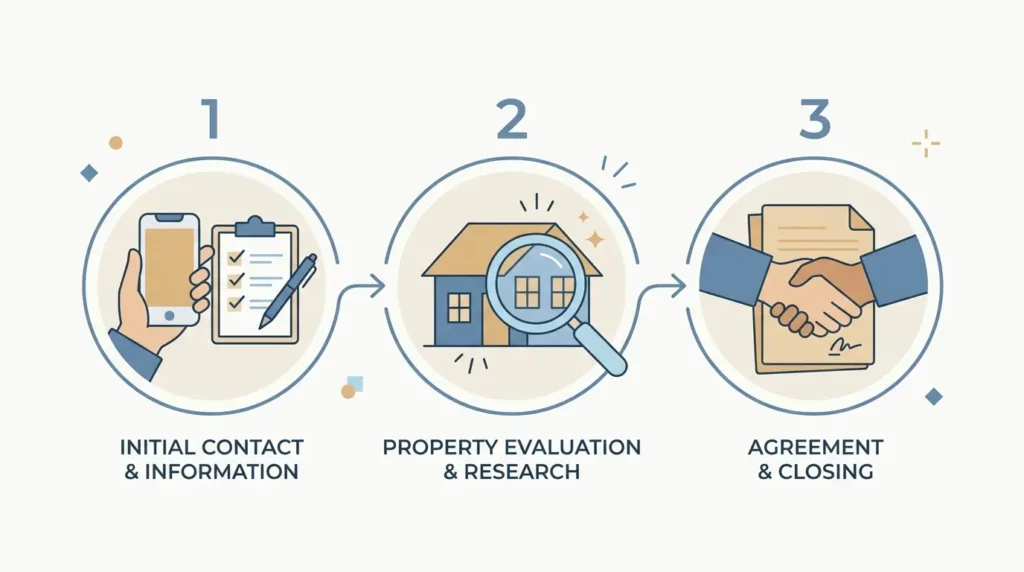
- Request an offer. Tell us the building, the unit, and what the inspection report actually said. No commitment, and no cost.
- We review the property and the building. We read the phase two report, the reserve study, and the assessment history, then present a fair cash offer based on condition and the local market. That is how our as-is purchase process works on any property, and a condo under repair simply has more documents to read.
- Close on your timeline. If the offer works, we handle the paperwork and close when you are ready, often within a few weeks depending on the association’s estoppel turnaround.
Not every owner should sell to us, and we would rather say so early. If the repair is scoped and funded, your assessment is manageable, and your unit shows well, list it. You will likely net more. The case for a cash sale is strongest when the assessment is larger than your equity, the repair timeline is open ended, or you cannot carry the unit through it.
What This Looks Like in Bay, Escambia, and Santa Rosa Counties
The Panhandle’s exposure here is arithmetic. Much of the beachfront inventory in Panama City Beach, Navarre Beach, and Perdido Key went up in the 1980s and early 1990s, which puts those buildings past the 30 year threshold now, and the salt water provision lets a local enforcement agency pull that in to 25.
In Bay County, milestone reports go to the local building official. The county’s Building Safety Division operates out of 840 West 11th Street in Panama City, and buildings inside the Panama City Beach city limits answer to that city’s building official instead. Perdido Key sits in unincorporated Escambia County, where Escambia County Building Services is the enforcement agency. Navarre Beach is unincorporated Santa Rosa County.
That detail is not trivia. The statute puts the repair deadline and the unsafe-for-occupancy determination in the hands of that specific local agency, so which desk your building’s report lands on affects the ordinance timeline your association is working against.
Frequently Asked Questions
What happens if my condo fails the milestone inspection?
A phase two inspection follows, and the association must distribute the inspector-prepared summary to every unit owner within 45 days of receiving the report. If substantial structural deterioration is confirmed, repairs must be commenced within 365 days. If they are not, the local enforcement agency must determine whether the building is unsafe for human occupancy.
What is the difference between a milestone inspection and a SIRS?
A milestone inspection is a structural safety inspection by a licensed engineer or architect, required at 30 years and every 10 years after. A structural integrity reserve study is a funding study that prices out the roof, structure, plumbing, electrical, waterproofing, windows, and exterior doors, then sets a reserve schedule. One asks if the building is safe, the other asks if the money exists.
Can I sell a condo that failed its milestone inspection?
Yes. Florida does not prohibit the sale, but it does require disclosure. You must give your buyer the inspector-prepared summary of the milestone report and the association’s most recent structural integrity reserve study, or a statement that one has not been completed. The practical obstacle is financing, not legality.
Who pays for the repairs after a failed milestone inspection?
Unit owners do, through the association. Reserves for the structural items may be funded by regular assessments, special assessments, lines of credit, or loans, and a special assessment or borrowing requires a majority vote of the total voting interests. Who covers an already levied assessment at closing is negotiable between buyer and seller.
Do lenders finance condos with a failed inspection?
Often not, or not on normal terms. Lenders evaluate the condominium project as well as the borrower, and an open phase two report with no funded repair plan is the kind of finding that stalls a loan file. That is why units in buildings under structural repair tend to trade to cash buyers rather than financed ones.
A failed milestone inspection changes your timeline and your buyer pool, but it does not take your options away. What it does is make the cost of waiting real: assessments get levied, deadlines arrive, and the decision gets made for you.
If you want a straightforward answer on what your Panama City Beach, Navarre Beach, or Perdido Key condo is worth as-is, inspection report and all, we are glad to give you one. No obligation and no pressure. Request a cash offer from Panhandle Real Estate Investments.

About Panhandle Real Estate Investments
I’m Peyton Saluto, founder of Panhandle Real Estate Investments. For over seven years, I’ve helped homeowners across the Florida Panhandle find fair and stress-free ways to sell their homes—no repairs, no commissions, and no pressure. My goal is always to put people first and make a real difference in our communities by restoring distressed properties and rebuilding neighborhoods. If you’re thinking about selling, reach out for a no-obligation cash offer. I’d love the opportunity to help you find the best path forward.