
Published by Panhandle Real Estate Investments, a locally owned real estate solutions company serving Bay County, Escambia County, Okaloosa County, and Santa Rosa County. We buy houses and land across the Florida Panhandle.
Last Updated: November 19, 2026
When a Florida house sells at a tax deed auction for more than the opening bid, the extra money does not go to the county and it does not go to the buyer. It is surplus, and under section 197.582 of the Florida Statutes, the Clerk of Court holds it for the people who had an interest in the property, starting with liens and ending with the former owner.
The catch is that nobody hands it over automatically. The Clerk mails a notice, and anyone who wants a share has to file a notarized claim. Lienholders who miss the 120-day deadline lose their claim for good. Owners get more room, but waiting rarely helps.
If you lost a home or a piece of land in Panama City, Pensacola, Crestview, or Milton to a tax deed sale, this guide covers who gets paid, the deadlines, how to file a claim yourself, and where each county posts its surplus list.
Key Takeaways
- Surplus is the money left over. It is the winning bid minus the opening bid, and the Clerk of Court holds it.
- Government liens are paid first. After that, senior mortgages and liens come before junior liens and the former owner.
- The claim window is 120 days from the notice. Lienholders who miss it are barred. Owners are not, but should still file early.
- You can file the claim yourself. The Clerk mails a claim form with the notice, and it must be notarized.
- Unclaimed surplus eventually goes to the state. It moves into Florida’s unclaimed property program, where it can still be claimed.
Table of Contents
- What tax deed surplus funds are
- Who gets paid first
- The 120-day clock and what it means for owners
- How to file a surplus claim, step by step
- Surplus recovery companies: read before you sign
- Surplus lists in Bay, Escambia, Okaloosa, and Santa Rosa Counties
- If the auction has not happened yet
- Frequently asked questions
What Tax Deed Surplus Funds Are
A tax deed auction starts at an opening bid that covers the certificate holder’s costs: the delinquent taxes, interest, and the fees to bring the property to sale. Bidders often go higher than that. Whatever the winning bid adds above the opening bid is surplus, sometimes called excess proceeds or overbid.
Homestead property gets one extra piece. For a homestead, Florida adds one-half of the latest assessed value to the opening bid, and section 197.582 says that added amount must be treated as surplus too. It matters if the house was your primary residence.
The Clerk pays the certificate holder what it is owed, then holds the rest and sends a Notice of Surplus Funds by mail to the owner and lienholders listed in the tax deed file. The notice states the sale date and the amount being held, and it comes with a claim form. If an address on the tax roll is out of date, that notice can miss you, which is one reason surplus goes unclaimed.
Who Gets Paid First
Surplus follows a set order, and the former owner is last in line.
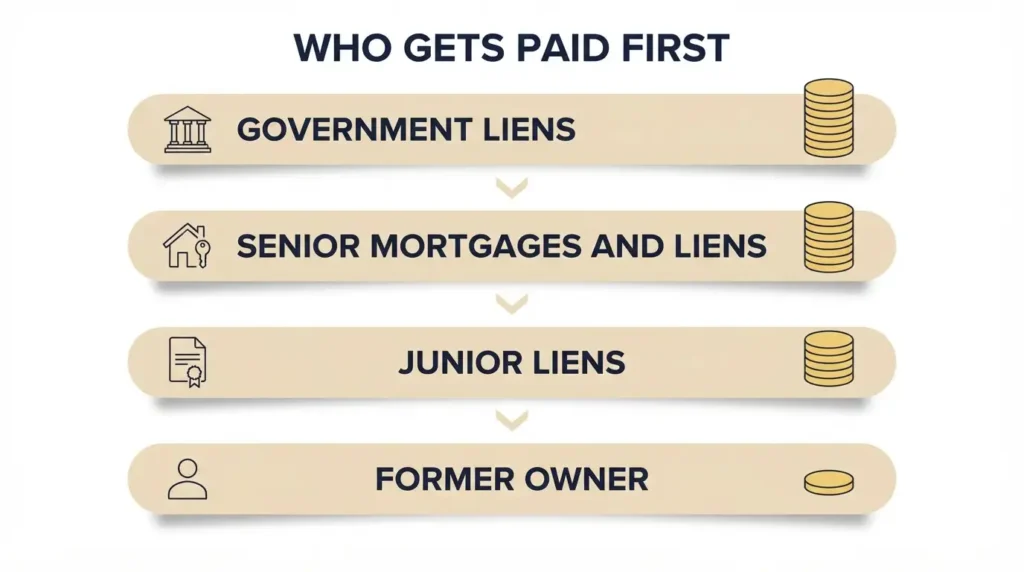
- Government liens. The Clerk first pays any lien of record held by a governmental unit, such as a city code enforcement lien, plus any tax certificates or omitted taxes not included in the deed application.
- Senior mortgages and liens. The statute’s notice says the funds will satisfy each senior mortgage or lien in full, to the extent possible, before anyone lower in line is paid.
- Junior mortgages and liens. A second mortgage, a court judgment, or an HOA lien gets paid next, in order of priority.
- The former owner. Whatever is left after valid liens goes to the titleholder who lost the property.
The Clerk also takes its service charges and mailing costs out of the surplus first. If you are not sure what liens are recorded against the property, our post on how liens and title problems get resolved at closing explains the common ones and how a title search finds them.
The 120-Day Clock and What It Means for Owners
The notice starts the clock. Under section 197.582, a person who receives the notice has 120 days from the date of the notice to file a written claim with the Clerk. After the claim period ends, the Clerk has 90 days to either pay the funds based on its review of the claims, or file an interpleader action in circuit court if the claims conflict. Court costs for an interpleader come out of the surplus.
Here is the part most people miss. The statute says claims not filed by the close of business on the 120th day are barred, except for claims by a property owner. A mortgage company or judgment creditor that misses the deadline waives its share. The former owner does not lose the right to claim just because the 120 days passed.
That does not mean you should wait. If no claims come in during the 120 days, the law presumes the legal titleholder of record is entitled to the money, and the Clerk processes it under Florida’s unclaimed property law. Government-held money that goes unclaimed for more than one year is presumed abandoned and is reported to the state.
How to File a Surplus Claim, Step by Step
Florida’s surplus statute includes a sample claim form, and each Clerk in the Panhandle uses a version of it. You do not need a lawyer to fill it out if the claim is simple. Here is the process.
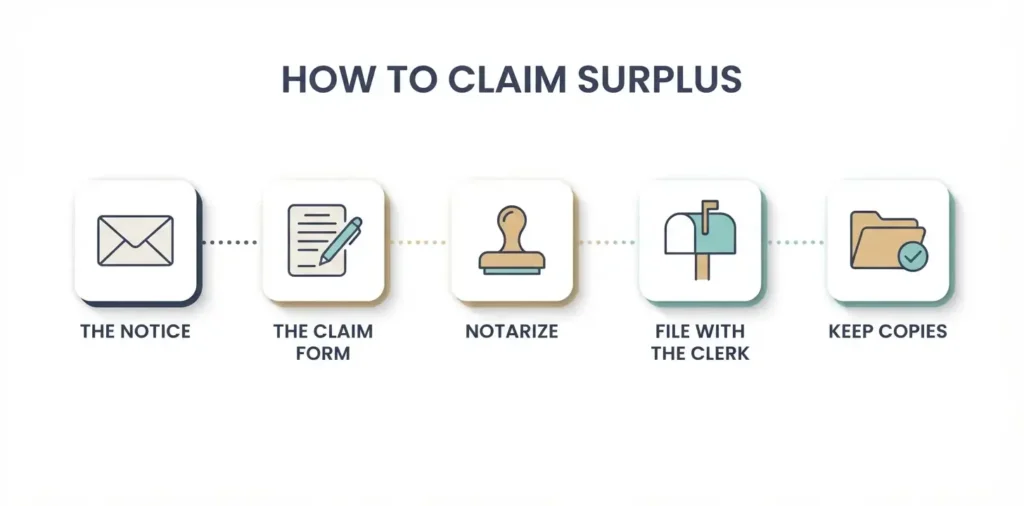
- Find your file. Use the Notice of Surplus Funds if you have it. If not, look up the property on your county Clerk’s tax deed or surplus list and note the tax deed number, certificate number, and sale date.
- Get the claim form. It comes with the mailed notice, and most Panhandle Clerks post it online. The form asks whether you are a lienholder or a titleholder.
- Fill out the titleholder section. List how you held title (a deed, a court judgment, or something else), the recording details if you know them, the amount you are claiming, and whether the property was your homestead.
- Sign in front of a notary. The statute requires a notarized statement of claim, and some Clerks let a deputy clerk witness it instead. Attach a copy of the notice.
- File it with the Clerk. By mail, the postmark is your filing date. By hand or courier, it is the day of delivery. Fax or email count only if your Clerk allows them.
- Keep copies. Save everything, including your mailing receipt. The Clerk will notify you once it decides who gets paid.
When a claim gets more complicated
- The owner has died. Heirs or the estate’s personal representative usually need court papers showing who inherits before a Clerk will pay, so talk with a Florida probate attorney.
- A lienholder disputes the amount. Conflicting claims are the main reason a Clerk files an interpleader, and an attorney is worth it at that point.
Surplus Recovery Companies: Read Before You Sign
After a tax deed sale, former owners often get letters and calls from companies offering to recover the surplus for a share of it. Some are legitimate and do real work on hard cases. On a simple owner claim, though, the work is often the same claim form you can file yourself, based on the same public list you can read for free.
The rules depend on where the money sits. Once surplus reaches the state’s unclaimed property program, Florida limits a registered claimant representative’s fees and costs to 30 percent of the claimed amount, requires a state-approved agreement, and allows payment only after the claim is approved. The surplus statute itself does not set a similar limit while the money is still with the Clerk, so read any agreement closely.
Before you sign anything, check these three things
- The amount and the fee. Look up your file on the Clerk’s surplus list first, then get the percentage, the dollar fee, and your net amount in writing.
- What they actually do. If the claim is a simple owner claim with no competing liens, you may not need help at all.
- Whether you are signing over the property or the claim. Do not sign a deed or an assignment you do not fully understand. If in doubt, have a Florida attorney read it first.
Surplus Lists in Bay, Escambia, Okaloosa, and Santa Rosa Counties
Every Clerk handles surplus a little differently, so start with the county where the property was sold.
Bay County (Panama City, Lynn Haven, Panama City Beach). The Bay County Clerk’s tax deed auctions page posts upcoming sales and the Claim to Surplus Proceeds form. It states that claims must be filed within 120 days of the surplus notice, except for property owner claims, and that its surplus process is managed by a private law office the page names. For how the Bay process runs before the sale, see our guide to Bay County tax deed sales.
Escambia County (Pensacola, Cantonment, Century). The Escambia County Clerk of the Circuit Court runs the auctions and holds the surplus, so call the Clerk’s tax deed office for the current list and claim form. Escambia also changed where owners redeem before a sale, which our Escambia County tax deed playbook explains.
Okaloosa County (Crestview, Fort Walton Beach, Niceville). The Clerk posts an Okaloosa tax deed surplus list that is updated after each sale. The Clerk’s tax deed FAQ says claims go on its Claim to Surplus Proceeds form, returned to the Clerk’s office.
Santa Rosa County (Milton, Pace, Navarre, Gulf Breeze). The Santa Rosa County Clerk’s foreclosures and tax deeds page links to both the tax deed surplus claim forms and a list of surplus money being held. Our post on how a tax deed sale unfolds in Santa Rosa County covers the steps leading up to it.
If years have passed and the Clerk no longer has the money, search Florida’s official unclaimed property site, FLTreasureHunt.gov, run by the Department of Financial Services.
If the Auction Has Not Happened Yet
If you are reading this before the sale, you still have more control than any surplus claim can give you. A surplus claim recovers only what bidders paid above the opening bid, after every lien is paid. A sale you plan yourself is priced on what the house is worth.
| Sell before the auction | Let it go to auction, then claim surplus | |
|---|---|---|
| Who sets the price | You and your buyer | Auction bidders |
| Back taxes and liens | Paid at closing by the title company | Paid from the surplus by the Clerk |
| What you receive | The rest of the sale price at closing | Whatever surplus is left after liens |
| Timing | Set by your closing date | After the claim period and the Clerk’s review |
| Paperwork | Handled by the title company | Your notarized claim, plus probate papers for heirs |
You own the house until the tax deed is issued, so you can sell it even after a deed application is filed. Our guide to selling a tax delinquent property before it reaches auction walks through the numbers. If the house shows well and the sale is months away, listing with an agent may bring the most money, and we will tell you that.
When time is short or the house needs work, an as-is cash sale can close before the auction. You can read answers to common questions about how we buy before you call.
How a sale with us works
- Tell us about the property and the sale date. There is no obligation.
- We check the title, the certificates, and the liens. Then we make a fair cash offer with the payoff math shown.
- Close before the auction. The title company pays the Tax Collector and any liens at closing, and you receive the rest.
Frequently Asked Questions
What are surplus funds from a tax deed sale?
Surplus funds are the money left when a property sells at a Florida tax deed auction for more than the opening bid. The Clerk of Court holds that money, pays government liens first, and then mails a notice to the owner and lienholders. For a homestead, half the assessed value added to the opening bid is also treated as surplus.
Who is entitled to surplus funds in Florida?
The people who had an interest in the property, in order of priority. Government liens are paid first, then senior mortgages and liens, then junior liens, and the former owner receives what is left. Each person must file a claim with the Clerk, and the Clerk decides who gets paid or asks a court to decide if claims conflict.
How long do I have to claim tax deed surplus funds?
The claim window is 120 days from the date of the Clerk’s surplus notice. Lienholders who miss it lose their claim, but Florida law exempts property owners from that bar. If nobody claims, the money is processed under the state’s unclaimed property law, so former owners should still file within the 120 days to avoid delays.
Do I need a lawyer to claim surplus funds?
Not always. A former owner with a simple claim can fill out the Clerk’s form, sign it before a notary, and file it alone. An attorney is worth it when the owner has died, several heirs or co-owners are involved, or a lienholder disputes the amount, because those cases can end up in an interpleader action in circuit court.
Should I use a surplus recovery company?
Only after you know what the money is and what you would pay. Many recovery companies file the same claim form you can file yourself. Once surplus reaches Florida’s unclaimed property program, fees are capped at 30 percent, but no similar cap applies while the Clerk holds it. Get the fee and your net amount in writing first.
Tax deed surplus belongs to the people who had a stake in the property, but only the ones who claim it get paid. Find your file, file a notarized claim within the 120 days, and keep copies of everything.

If your property has not gone to auction yet and you want to know what it is worth as-is in Panama City, Pensacola, Crestview, or Milton, we are happy to give you a straight answer. No obligation, no pressure. Request a cash offer from Panhandle Real Estate Investments.

About Panhandle Real Estate Investments
I’m Peyton Saluto, founder of Panhandle Real Estate Investments. For over seven years, I’ve helped homeowners across the Florida Panhandle find fair and stress-free ways to sell their homes—no repairs, no commissions, and no pressure. My goal is always to put people first and make a real difference in our communities by restoring distressed properties and rebuilding neighborhoods.
If you’re thinking about selling, reach out for a no-obligation cash offer. I’d love the opportunity to help you find the best path forward.