
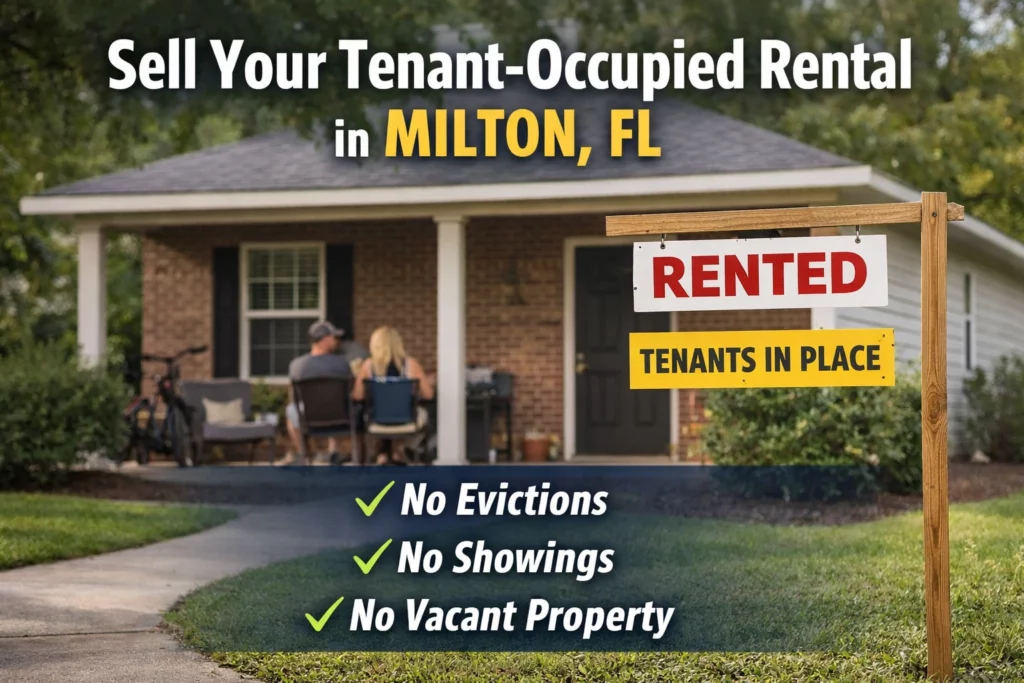
Tenant Problems in Milton? Sell a Rental Without Eviction or Showings
Owning a rental in Milton can look pretty good from a distance. Monthly income, long-term appreciation, maybe a nice little asset to hold onto. Then real life shows up.
A tenant starts paying late. The property needs work. Access gets awkward. Communication gets tense. Or maybe the numbers just do not make sense anymore. What started as an investment turns into one more thing draining your time, attention, and patience.
If that is where you are, there is some good news. Selling a tenant-occupied rental is often a lot more doable than landlords think. In many cases, you do not need to evict first. You do not always need to list the property. You do not need a bunch of showings. And you may not have to deliver the property vacant at closing if the buyer is willing to purchase with the tenant in place and honor the existing tenancy. Florida’s residential landlord-tenant rules in Chapter 83 cover lease rights, access, termination notice, and security deposits, which is why the cleanest exit is usually the one built around the actual lease instead of wishful thinking.
We have purchased multiple properties in the area with tenants in place. Some sellers want the tenant looped in early. Some do not want to create panic or unnecessary drama before there is a clear plan. That is understandable. In those situations, discretion matters. A lot. Inspections can often be handled quietly and professionally, without turning the property into a circus.
If you are ready to move on from a rental in Milton, this guide walks through how the process usually works, what Florida law does and does not require, and why a direct sale can make life easier for landlords who want a clean exit. We buy houses in Milton and regularly work with landlords who want to sell without evictions or showings.
Why Milton landlords start looking for an exit
There is usually more than one reason.
Sometimes the property is cash-flowing, but just barely. A roof issue, HVAC replacement, plumbing problem, or turnover can wipe out months of profit in a hurry. Sometimes the tenant is not terrible, but the relationship has gotten uncomfortable enough that you dread every phone call. Sometimes rent is inconsistent and you are tired of deciding whether to chase it, waive it, or start a process you do not really want to deal with.
Then there are the properties that come with life baggage. A rental gets inherited. A divorce changes things. A landlord moves out of state. A job changes. A family member needs help. Suddenly owning a rental in Santa Rosa County is not a smart long-term play. It is just one more problem on the list.
That is usually when landlords start asking the same question: do I really have to get the property empty before I can sell? A lot of landlords are surprised to learn you can often sell a rental property with tenants in Florida without waiting for it to be vacant.
Not always.
Can you sell a rental in Milton without evicting the tenant first?
Yes, often you can.
A sale does not automatically wipe out a valid tenancy. If there is a real lease in place, the buyer typically steps into the landlord’s shoes and takes the property subject to that lease. If the tenancy is month-to-month, there may be more flexibility, but Florida still has notice rules for ending it. The basic point is simple: title can transfer, but that does not make the tenant disappear.
That is one of the biggest misconceptions landlords have. They assume a sale means the house has to be empty, cleaned up, fully available for showings, and ready for the retail market. That can be true in a traditional listing. It is not always true in a direct sale.
If the buyer is comfortable buying a tenant-occupied property, the seller may be able to close without forcing a vacancy first. That matters for landlords who do not want the cost, risk, or hassle of an eviction fight. It also matters for landlords who have a paying tenant and simply want out.
In plain English, you may be able to sell the property as it sits, with the tenant still there.
Why a traditional listing can get messy fast
A tenant-occupied property and a retail listing are often a bad mix.
On paper, listing with an agent sounds like the obvious move. In practice, an occupied rental can make that route a headache. Agents want photos. Buyers want walkthroughs. Inspectors want appointments. Appraisers want access. Everyone wants a piece of the calendar, and the tenant is usually the person standing in the middle of it all.
That is where things get weird.
Some tenants cooperate. Some do not. Some feel anxious the moment they hear the word “sale.” Some start worrying about being pushed out, even if nobody has said that. Some stop picking up the phone. Some suddenly become hard to schedule around. A property that was annoying but manageable turns into an emotional landmine.
That is why some landlords prefer a direct buyer. Instead of dealing with repeated access requests and open-market uncertainty, they want one buyer, one plan, and as little disruption as possible.
For owners trying to avoid repairs, listings, and back-and-forth, and want to sell your house fast in Florida there is a much easier way to do it.
What Florida law means for occupied sales
This is where people tend to get turned around, so let’s keep it simple.
Florida Chapter 83 is the main body of law for residential tenancies. A few sections matter more than others when you are selling an occupied property.
Landlord access: Florida law gives landlords a right of reasonable access, but not a blank check. Access generally has to be at a reasonable time and with reasonable notice, with some exceptions for emergencies. That matters because a sale does not give you permission to turn the property into Grand Central Station.
Termination notice: If the tenant is month-to-month or another non-fixed term tenancy, Florida law sets notice periods for termination. That does not mean you have to terminate to sell. It just means the tenancy structure matters, and you should know what kind of arrangement you actually have before making decisions.
Security deposits: Florida also has specific rules around security deposits, including notice requirements and timing for claims after the tenant vacates. If a property is being sold with a tenant in place, the deposit and lease records need to be handled carefully so there is no confusion about who is holding what and what gets transferred.
That is why good paperwork matters. A lot of deals get easier once everyone is working from the same facts instead of guesses.
You do not always have to tell the tenant right away
This is one of the touchier parts of the process, but it is real.
Some landlords do not want the tenant to know the property is being sold until there is a real plan. Not because they are trying to hide something shady. Usually it is the opposite. They do not want to create unnecessary fear, tension, or conflict when there is nothing the tenant actually needs to do yet.
That concern is reasonable.
If a tenant hears “I’m selling,” they may assume eviction is coming, even when the lease will be honored. That can change the whole tone of the relationship overnight. Suddenly they are defensive, worried, or suspicious. Access gets harder. Communication gets weird. The property gets harder to manage than it was before.
That is one reason a discreet buyer can be helpful. A lot of occupied deals do not require a parade of agents, open houses, and repeated disruptions. In some cases, the property can be evaluated with very limited access. In others, one quiet visit is enough to get the deal moving. The goal is not to stir the pot. The goal is to help the seller exit without making the situation more stressful than it needs to be.
What an estoppel letter does, and why it matters
If you are selling an occupied rental, one of the smartest things you can gather is an estoppel letter or estoppel-style tenant summary.
This is basically a written confirmation of the key facts of the tenancy. It can include:
- tenant names
- lease start and end dates
- current rent amount
- security deposit held
- whether rent is current or behind
- whether there are side agreements, concessions, or repair issues
- whether there are any disputes the buyer should know about
It is not magic. It is just clarity. And clarity is gold in an occupied sale.
A buyer looking at a tenant-occupied property wants to know what they are inheriting. Is the lease real? Is rent current? Is there a deposit? Are there unresolved issues? The clearer that picture is, the easier it is to move forward with confidence.
When that information is missing, buyers start mentally adding risk to the deal. And risk usually means slower decisions and lower offers.
When selling with the tenant in place makes the most sense
This route usually works best in a few common scenarios.
1. The tenant is paying and the lease is decent
If the tenant is stable enough and the buyer is comfortable keeping them, there may be no reason to force vacancy.
2. The property needs work
A retail buyer may want repairs, cleanup, and easy access. A direct buyer is often more flexible.
3. The landlord wants a quiet exit
Some owners are done being landlords and just want to move on without a long, noisy sales process.
4. The landlord does not want an eviction fight
Eviction can cost time, money, and emotional energy. If a buyer will take the property occupied, that may be the smoother path.
5. The property came from inheritance or family complications
Occupied inherited properties can be especially tricky. If that is part of your situation, selling an inherited property in Florida may be something that you’re thinking about.
When vacancy may still make more sense
To be fair, selling occupied is not always the best option.
There are cases where delivering the property vacant can open up more buyer demand or make the process easier. That can be true if:
- the tenant is actively destructive
- access is impossible
- there are serious lease violations
- the property will photograph badly and you want top retail pricing
- the tenant relationship is so unstable that a buyer will see it as a major liability
The right answer depends on your goals. If your priority is absolute top-dollar retail value, vacancy might help. If your priority is simplicity, speed, and avoiding drama, an occupied sale may be the better play.
Decision matrix: sell occupied, evict first, or list traditionally?
Here is the practical version.
| Option | Best for | Pros | Cons |
|---|---|---|---|
| Sell with tenant in place | Landlords who want a clean exit with less disruption | No need for repeated showings, may avoid eviction, can often sell as-is | Buyer pool is smaller than full retail |
| Evict first, then sell | Owners who need full control before marketing | Easier access, broader buyer pool after vacancy | Time, cost, stress, legal process |
| List traditionally with tenant inside | Owners chasing max retail and willing to manage the hassle | Possible higher sale price in some cases | Showings, scheduling, tenant tension, uncertainty |
For a lot of tired landlords, the winner is not the one that looks best in a spreadsheet. It is the one that lets them breathe again.
Timeline comparison
Here is how the three paths often feel in the real world.
| Path | What usually happens |
|---|---|
| Sell occupied to a direct buyer | Review lease, verify tenant details, limited inspection, title work, close |
| Evict first, then sell | Notices, waiting periods, possible court process, vacancy, cleanup, marketing, showings, contract, closing |
| List with tenant in place | Prep property, coordinate photos, showings, inspections, buyer financing, closing delays |
That does not mean every direct sale is instant or every listing is a disaster. It just means one path usually has fewer moving parts.
If you want a simple overview of the direct-sale route, how we buy houses lays it out pretty clearly.
A realistic landlord exit checklist
Before talking to any buyer, gather as much of this as you can:
- current lease and any renewals
- tenant names and occupancy details
- rent amount and due date
- payment history
- security deposit amount
- notices already given, if any
- known repair issues
- utility responsibilities
- whether the tenant knows you may sell
- whether you want the process handled quietly
- any access limitations
- HOA or code issues if they exist
You do not need a perfect file. But the more organized you are, the easier the conversation gets.
Sample deal breakdown
Every property is different, but here is a simple example of how a landlord may compare the choices.
| Item | Traditional occupied listing | Direct occupied sale |
|---|---|---|
| Paint, cleanup, prep | $3,500 | $0 |
| Holding costs during marketing | $2,000 | Lower due to shorter process |
| Showings and tenant coordination | High hassle | Minimal |
| Risk of buyer fallout | Moderate to high | Usually lower with direct buyer |
| Need to deliver vacant | Often preferred | Not always required |
| Speed and certainty | Less predictable | More predictable |
The point is not that every direct sale pays more. Sometimes it does not. The point is that net convenience matters too. A slightly lower headline number can still be the better outcome when you factor in time, repairs, tenant friction, and uncertainty.
What about HUD or voucher tenants?
If your tenant is in a housing program, extra care is smart.
HUD has landlord and tenant resources for Housing Choice Voucher and public housing situations, and those relationships may involve additional paperwork, inspections, or communication steps depending on the local program. That does not automatically make a sale difficult. It just means you want the lease file, payment information, and housing-program details organized before the property changes hands.
That is another reason discretion and documentation matter. Program-related tenants are not impossible. They just require a more thoughtful handoff.
What the Santa Rosa County Clerk can help you verify
If you are sorting through ownership questions, recorded documents, liens, or other public-record issues tied to the property, the Santa Rosa County Clerk’s office can be a useful place to confirm what is actually on file. The Clerk provides access to public records and official records resources for Santa Rosa County.
That does not replace title work, of course. But it can help landlords get their bearings before they start the sale process.
Pros and cons of selling a tenant-occupied rental directly
Pros
- no need for repeated showings
- may not need to deliver the property vacant
- can often avoid repair costs
- less disruption for you and the tenant
- easier to keep the process calm and quiet
- better fit for landlords who want out fast
Cons
- smaller buyer pool than a vacant retail listing
- offer may reflect the complexity of the tenancy
- documentation matters more
- not every buyer knows how to handle occupied closings properly
That last point is worth saying out loud. An occupied rental sale is not the place for a buyer who is winging it.
A few mistakes landlords make when trying to sell occupied
Acting like the lease does not matter
It matters. A lot.
Promising vacant delivery without a real plan
That can backfire fast.
Letting buyers wander in and out
Access needs to be reasonable and controlled under Florida law.
Failing to organize deposit and rent records
That creates confusion right when clarity matters most.
Telling the tenant too much too early, or too little too late
This is a judgment call. Timing matters.
The bottom line for Milton landlords
If you are tired of dealing with a rental in Milton, you may not need to force an eviction, wait for vacancy, or put the property through a full retail sales process just to move on.
A tenant-occupied sale can work. Sometimes really well.
The key is understanding what you are selling, being honest about the tenant situation, and working with a buyer who is comfortable purchasing an occupied property without making everything harder than it needs to be. In many cases, the cleanest exit is not the prettiest one. It is the one with the fewest moving parts, the least drama, and the most certainty.
We have bought multiple properties in the area with tenants in place, and we understand that some sellers want the process handled quietly. If that is your situation, that is fine. You do not have to deliver the property vacant, and you do not have to turn the sale into a production with endless showings.
If you want to talk through the property and see what a direct sale could look like, reach out to Panhandle Real Estate Investments at 850-778-2212 or visit thepanhandlehomebuyer.com.

About Panhandle Real Estate Investments
I’m Peyton Saluto, founder of Panhandle Real Estate Investments. For over seven years, I’ve helped homeowners across the Florida Panhandle find fair and stress-free ways to sell their homes—no repairs, no commissions, and no pressure. My goal is always to put people first and make a real difference in our communities by restoring distressed properties and rebuilding neighborhoods. If you’re thinking about selling, reach out for a no-obligation cash offer. I’d love the opportunity to help you find the best path forward.