
Published by Panhandle Real Estate Investments, a locally owned real estate solutions company serving Bay County, Okaloosa County, Santa Rosa County, and Escambia County. We buy houses and land across the Florida Panhandle.
Last Updated: September 28, 2026
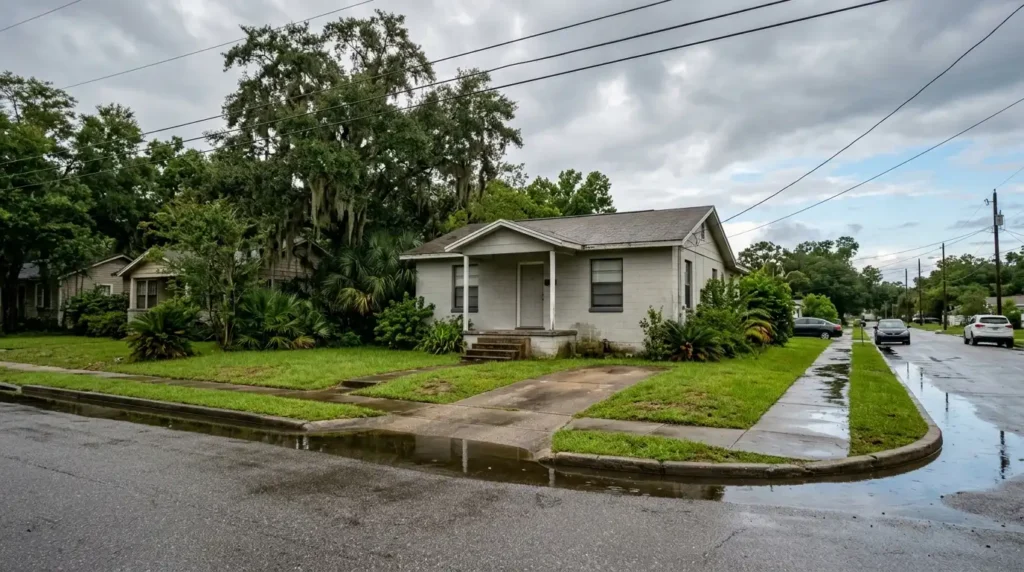
After a storm floods a Panama City or Mexico Beach home, the number that decides your future is not on the adjuster’s estimate. It is a percentage. If the cost to repair your home reaches half of what the structure is worth, Bay County can require you to rebuild the entire house to current flood code before anyone lives in it again. That is FEMA’s 50 percent rule, and thousands of Bay County owners ran straight into it after Hurricane Michael.
The rule catches people off guard because it has nothing to do with how bad the damage looks or whether your insurance pays. It is a straight math test: repair cost against the market value of the structure. Cross the line, and a simple repair turns into a full code upgrade that can cost far more than the original damage.
This post walks through what the rule actually is, how Bay County measures it, what counts toward the 50 percent, and what owners do when the rebuild requirement outruns their budget.
Key Takeaways
- It is a math test, not a judgment call. If repair costs reach 50 percent of your structure’s market value, the whole home must be brought up to current floodplain code.
- It is measured on the structure, not the land, and on the full cost to fully repair the home, even work you do not plan to do yourself.
- Compliance usually means elevation. In many Bay County flood zones, meeting code means raising the home to the base flood elevation before you can rebuild.
- A substantial damage letter can stall a sale. Financed buyers often walk because their lender will not fund a home that has to be elevated first.
- When the rebuild cost outruns your budget, selling as-is to a cash buyer is often the cleaner exit.
Table of Contents
- What FEMA’s 50 percent rule actually is
- How Bay County measures the 50 percent
- Your options when repairs cross the line
- How selling to Panhandle Real Estate Investments works
- Panama City, Mexico Beach, and Bay County specifics
- Frequently asked questions
What FEMA’s 50 Percent Rule Actually Is
FEMA’s 50 percent rule comes out of the National Flood Insurance Program, which Bay County joined in exchange for its residents being able to buy flood insurance. In return, the county agreed to enforce floodplain management standards on any building in a special flood hazard area. The 50 percent rule is the sharpest of those standards.
The rule has two triggers that work the same way. A substantial improvement is any work whose cost equals or exceeds 50 percent of the market value of the structure before the work starts. Substantial damage is the storm version: damage where the cost to restore the home to its before-damage condition would reach that same 50 percent. Hit either one, and the building is no longer grandfathered under old rules.

Once a home is declared substantially damaged or substantially improved, it has to meet current floodplain code, not the code it was built under. In most of Bay County’s flood zones that means the living space has to sit at or above the base flood elevation, which older ground-level homes almost never do. This is closely tied to selling with an open insurance claim after a storm, because the claim outcome and the substantial damage finding often land at the same time.
How Bay County Measures the 50 Percent
The test is a fraction. Bay County takes the full cost to repair the structure and divides it by the structure’s market value, land excluded. If the result reaches 50 percent, the home is substantially damaged. In Florida these determinations are the responsibility of the local building official and floodplain administrator, which in this county is Bay County Building Services, not FEMA and not your insurer.
Two details trip people up. First, the repair cost is the cost to fully restore the home, even if you only plan to do part of the work. Patching half the drywall does not lower the number. Second, market value means the value of the structure alone, so a modest block home on a valuable Panama City Beach lot can cross 50 percent faster than owners expect, because the land value is stripped out.
Here is a plain look at what generally counts toward the 50 percent and what does not. Your local floodplain administrator makes the final call on any gray area.
| Generally counts toward the 50% | Generally does not count |
|---|---|
| Labor and materials for structural repairs | The value of the land |
| Framing, roofing, drywall, insulation | Plans, surveys, and permit fees |
| Electrical, plumbing, and HVAC restoration | Debris removal and cleanup |
| Built-in cabinets, flooring, and finishes | Detached structures like a separate shed |
| All work needed to fully restore the home | Some outdoor items like decks or landscaping |
The takeaway is that the number climbs quietly. Between full-restoration accounting and land value being removed from the denominator, a lot of Bay County homes that look repairable land on the wrong side of 50 percent.
Your Options When Repairs Cross the Line
Once you are over 50 percent, you have three honest paths.
Rebuild to code and keep the home. You can do the full compliant rebuild, which usually means elevating the structure to the base flood elevation. It is the right move if you have the money and want to stay, but elevation and code upgrades can cost far more than the storm repair that triggered the rule in the first place.
List it on the open market. You can try to sell the traditional way, but a substantial damage determination is a hard sell to a financed buyer, whose lender will not fund a home that has to be elevated before it is livable. That is the same dynamic behind how we price severely damaged homes and still close as-is when the retail market backs away.
Sell directly to a cash buyer, or sell the lot. A cash buyer can take the home with the determination in place, so the rebuild requirement stops being your problem. If the structure is too far gone, you can also sell a Panama City lot outright and let the buyer handle demolition and elevation.
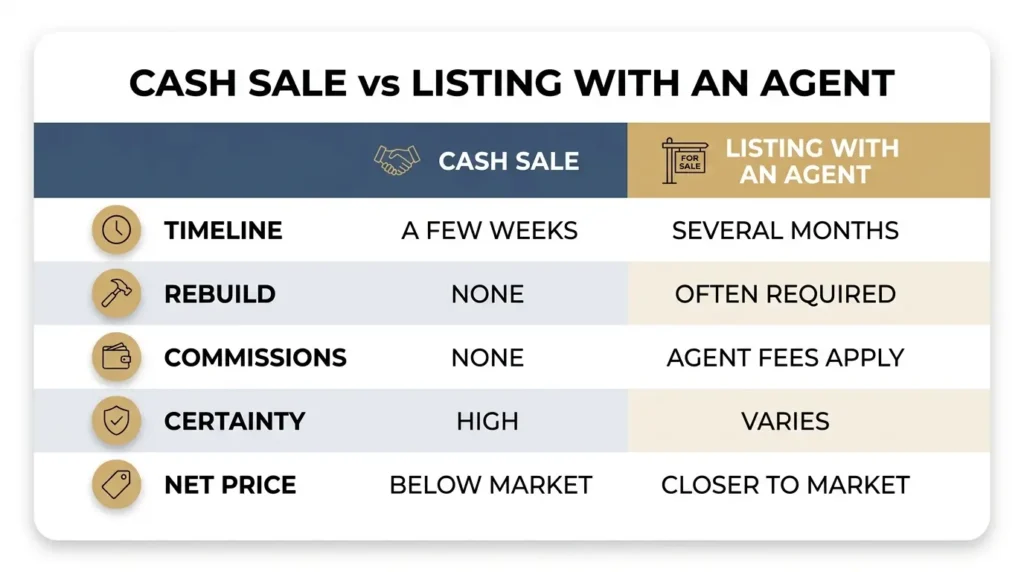
| Factor | Cash Sale (As-Is) | Listing With an Agent |
|---|---|---|
| Timeline | Often within a few weeks | Typically 60 to 120 days or more |
| Code rebuild / elevation | Not your problem, we buy as-is | Often required before a financed buyer can close |
| Substantial damage letter | We buy with it in place | Can stall or kill the sale |
| Buyer pool | Cash buyers who price the rebuild in | Mostly financed buyers whose lender needs a livable home |
| Commissions | None | Typically 5 to 6 percent |
| Certainty of close | High | Subject to financing, inspection, appraisal |
| Net price | Below market, minus no rebuild bills | Closer to market, before the rebuild and costs |
For a side-by-side on the tradeoffs, we keep an honest cash offer versus agent listing comparison that lays it out without the sales spin. The right answer is whichever path nets you the most after the rebuild and the elevation are accounted for, not whichever headline price looks biggest.
How Selling to Panhandle Real Estate Investments Works
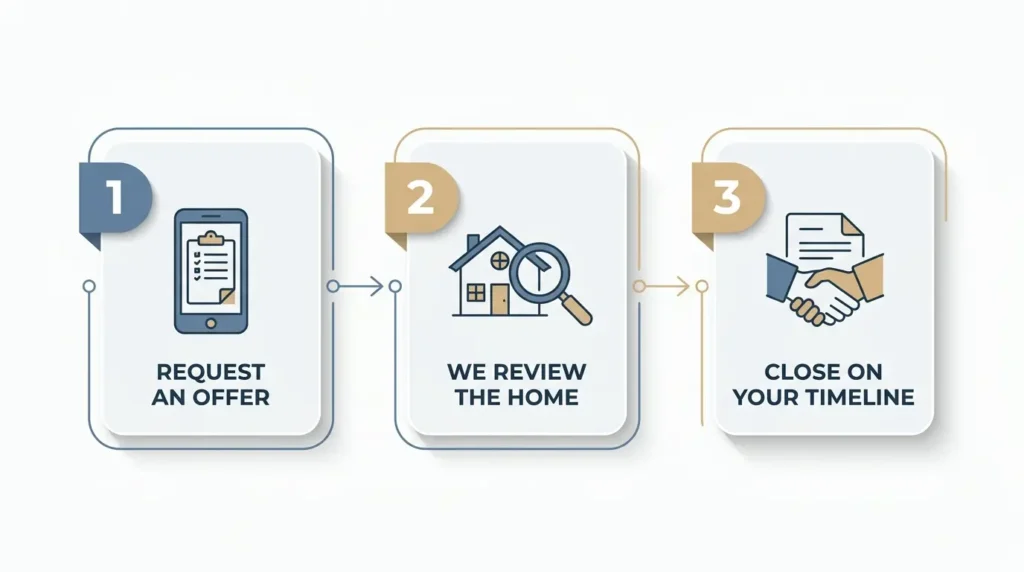
If a cash sale is the right exit, the process is short and there is no obligation to accept anything.
- Request an offer. Tell us about the home, the flood damage, and where the substantial damage determination stands if you have one. It takes a few minutes and there is no commitment.
- We look at the damage and the numbers. We estimate the repairs and the code requirements and build them into a fair cash offer, with the math shown rather than hidden. A substantial damage letter does not scare us off.
- Close on your timeline. If the offer works, we handle the paperwork and close when you are ready, with no rebuild to finish and no elevation to pay for first.
Not every owner should sell. If the damage is minor, you stayed under 50 percent, and you can absorb the repair, keeping the home may be the better move, and we will tell you so plainly when it is true for your situation.
Panama City, Mexico Beach, and Bay County Specifics
Bay County learned this rule the hard way after Hurricane Michael, when substantial damage determinations hit block after block in Panama City, Springfield, and Mexico Beach. Owners who assumed they would patch and move back in found out their homes had to be elevated to the base flood elevation first, and many could not afford it. That legacy still shapes the market here.
Coastal parts of the county carry the harshest zones. A home in a V zone along the Panama City Beach or Mexico Beach coast faces stricter and more expensive elevation standards than a home in an inland AE zone, and an elevation certificate is what proves where a structure actually sits. This is not happening in isolation either, and it fits inside the wider picture of selling storm damaged homes in the Panhandle where insurance, flood rules, and rebuild costs all pull in the same direction.
It also means local cash buyers already understand these determinations and these zones. A substantially damaged home with an unaffordable elevation requirement in Panama City is routine to an investor here, not a dealbreaker. If the 50 percent math is what is pushing you to sell, that is the part of the market that stays open to you.
Frequently Asked Questions
What is FEMA’s 50 percent rule?
FEMA’s 50 percent rule says that if the cost to repair or improve a building equals or exceeds 50 percent of the structure’s market value, the whole building must be brought up to current floodplain code. It applies to structures in a special flood hazard area under the National Flood Insurance Program, and Bay County enforces it locally.
How does Bay County calculate the 50 percent threshold?
Bay County compares the full cost to repair the structure to its pre-damage market value, not counting the land. A local floodplain official divides the repair cost by the structure’s market value, and if that figure reaches 50 percent, the home is substantially damaged. It then has to meet current base flood elevation and code requirements before it can be occupied again.
What counts toward the 50 percent, labor or materials?
Both. The cost estimate includes labor and materials for all work needed to fully restore the structure to its before-damage condition, even work you do not plan to do. It generally excludes the land value, and some items like plans, permit fees, and debris removal may be treated separately. Your local floodplain administrator makes the final call.
What happens if my repairs exceed 50 percent?
If repairs cross the 50 percent line, the structure is declared substantially damaged and must be brought into full compliance with current floodplain rules. In many Bay County flood zones that means elevating the home to or above the base flood elevation before you can rebuild, which can cost far more than the original repair. Selling as-is is one way out.
Can I sell a house that has been declared substantially damaged?
Yes. A substantial damage determination does not stop you from selling. It becomes part of the property’s disclosure, and financed buyers often walk because their lender will not fund a home that needs to be elevated first. A cash buyer can take the home with the determination in place, which is why many owners in this spot sell directly.
The 50 percent rule does not have to trap you. Whether you rebuild to code and stay, or decide the elevation math is your signal to sell, the right move comes down to your numbers, and knowing the as-is value is the fastest way to see them clearly.
If you want to know what your Panama City, Panama City Beach, or Mexico Beach home is worth as-is, flood damage and substantial damage letter included, we are happy to give you a straightforward answer. No obligation, no pressure. Request a cash offer from Panhandle Real Estate Investments.

About Panhandle Real Estate Investments
I’m Peyton Saluto, founder of Panhandle Real Estate Investments. For over seven years, I’ve helped homeowners across the Florida Panhandle find fair and stress-free ways to sell their homes—no repairs, no commissions, and no pressure. My goal is always to put people first and make a real difference in our communities by restoring distressed properties and rebuilding neighborhoods. If you’re thinking about selling, reach out for a no-obligation cash offer. I’d love the opportunity to help you find the best path forward.