
Behind on Property Taxes in Florida? Your Options Before a Tax Certificate Sale (Crestview)
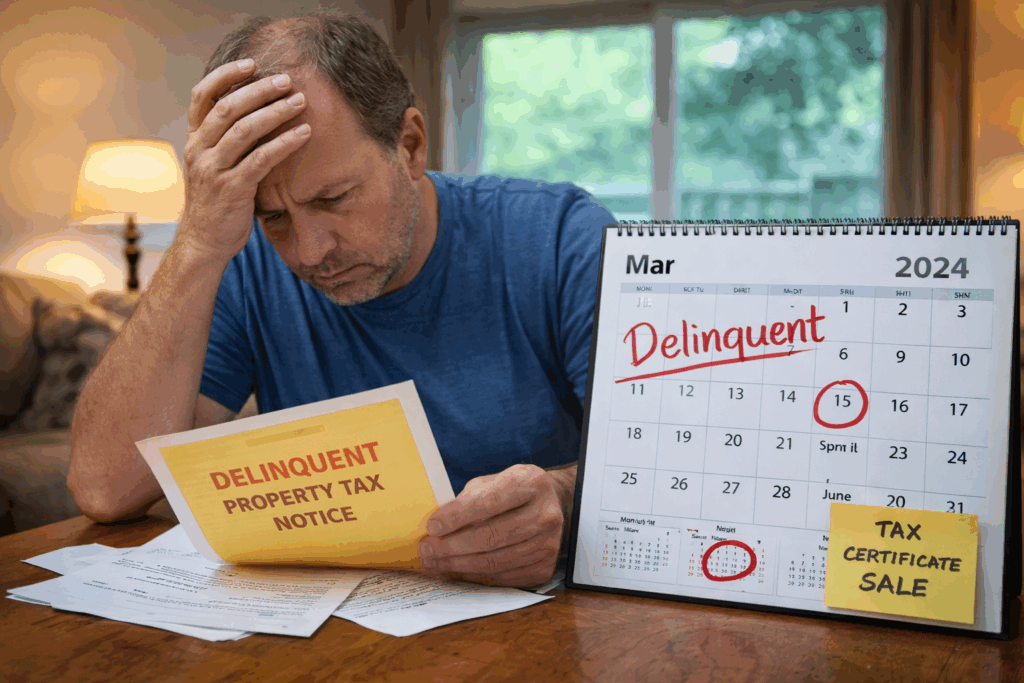
If you are behind on property taxes in Crestview, it can feel like a countdown you did not choose. Maybe you opened a notice and saw the word “delinquent.” Maybe you heard “tax certificate sale” and assumed it means you are about to lose your home.
Take a breath. In Florida, the process has steps, dates, and options. A tax certificate sale is usually the beginning of a lien process, not an instant loss of ownership. The most important thing is understanding the timeline so you can choose the best next move for your situation.
Below is Florida’s delinquent property tax process in plain English, with key dates, the fees and interest that can add up, and the options homeowners in Crestview have, including selling as-is to pay off taxes at closing. If you’re in a similar situation further east, see how we help homeowners in Tallahassee behind on property taxes.
Florida’s delinquent property tax process in plain English
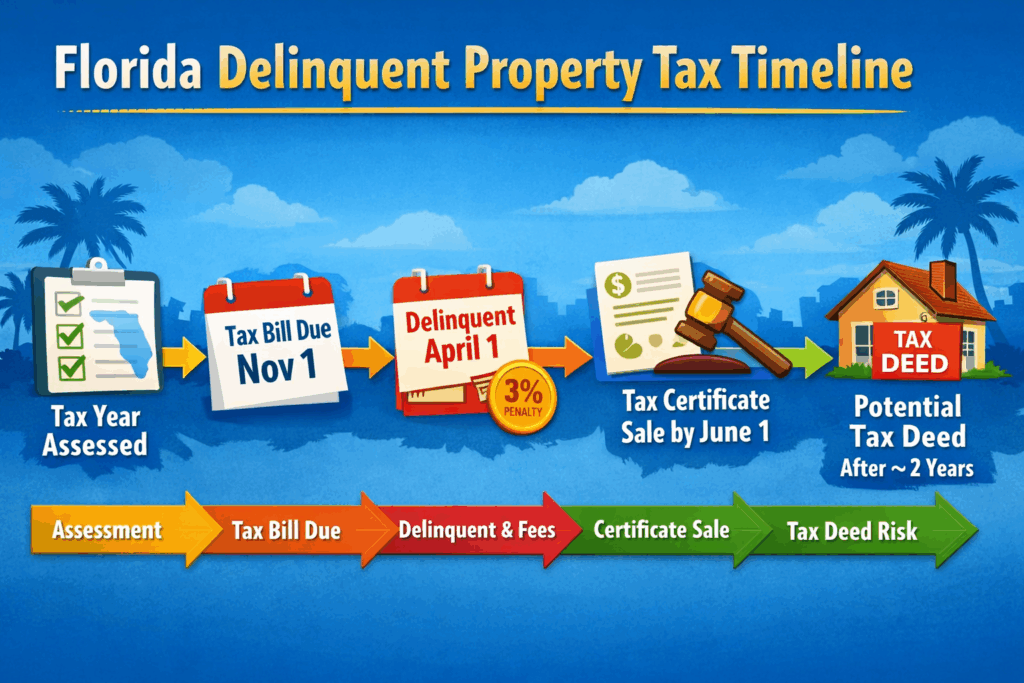
Step 1: Taxes are billed, then become delinquent (April 1 in most cases)
In Florida, property taxes are generally due starting November 1 for that tax year. If they are not paid, they become delinquent on April 1 of the following year (or later in certain notice-timing situations).
The Florida Department of Revenue summarizes it simply: if you do not pay, they become delinquent April 1, and tax certificates are sold on unpaid accounts by June 1.
For Crestview homeowners, Okaloosa County resources commonly refer to the same timing: all taxes become delinquent April 1, and the certificate sale begins on or before June 1.
Step 2: Penalties and costs start stacking
Once taxes are delinquent, the amount due is no longer “just the tax bill.” Counties typically add:
- A delinquency penalty (many Florida tax collector calendars reference 3%)
- Advertising costs (delinquent parcels are advertised)
- Other collection-related costs depending on the county’s process
The key idea is that waiting usually increases the payoff.
Step 3: The tax certificate sale happens (on or before June 1)
Florida law requires the tax collector to conduct a tax certificate sale each year for unpaid taxes.
In Okaloosa County, the tax certificate sale is explained as a reverse auction: bidding starts at 18% (the maximum) and bidders compete by bidding the interest rate down.
Important: A tax certificate is a lien, not a deed. The certificate holder generally does not become the owner just because they bought a certificate. (Ownership risk comes later if the process moves toward a tax deed.)
Okaloosa’s clerk resources describe it directly: taxes become delinquent April 1, and a tax certificate is sold for unpaid taxes not paid by the sale date, and it is a lien.
Step 4: You can redeem the certificate by paying what’s required
If a certificate is sold, you can typically “redeem” it by paying the tax collector:
- The face amount (taxes, costs, etc.)
- Plus interest based on the certificate’s bid rate, with a mandatory minimum of 5% in many cases
That 5% minimum is a big deal. Even if the bidding drives the interest rate very low, Florida law can still require at least a 5% minimum charge when you redeem.
Step 5: After about two years, tax deed risk becomes real
A common misconception is “the tax certificate sale means I lose my house.” Usually, that is not what happens. The bigger risk window is later.
In Florida, a tax certificate holder may apply for a tax deed after 2 years have elapsed since April 1 of the year the certificate was issued (and before the certificate is canceled).
That is when a property can move toward a tax deed sale if the amounts are not paid.
Your options if you’re behind on property taxes in Crestview
Here are the most common paths homeowners consider before (and even after) a tax certificate sale.
Option 1: Pay the taxes in full before delinquency or as soon as possible after
If you can pay, paying sooner usually limits penalties, advertising costs, and the chance a certificate is sold.
Best for: homeowners who can access savings, family help, or a short-term loan without putting themselves in a worse position.
Option 2: Make partial payments (for current-year taxes, before April 1)
Florida law allows tax collectors to accept partial payments for current-year taxes in many cases, but there are rules and usually paperwork.
Partial payments often have tradeoffs:
- You typically lose early-payment discounts
- There may be processing fees (the statute references a processing fee for partial payments)
- Partial payments generally stop once taxes are delinquent (April 1)
Best for: homeowners who can pay something now but not everything, and want to avoid delinquency.
Option 3: Use Florida’s installment plan (prepay in installments)
Florida also allows an installment payment method for property taxes (this is usually set up in advance).
The Department of Revenue notes that taxpayers who want to prepay on the installment plan generally file an application with the tax collector by May 1 of the assessment year.
Best for: homeowners planning ahead for next year’s bill, especially if income is predictable but tight.
Option 4: Ask your county tax collector what programs exist locally
Counties do not all handle customer service and payment logistics the same way. Some accept certain payment methods for delinquent taxes, some require certified funds, and some provide guidance pages for delinquent taxes.
For example, Okaloosa County publishes reminders like “all taxes become delinquent April 1” and notes the certificate sale timing.
Best for: anyone unsure what applies to their parcel, especially if you’ve received notices.
Option 5: Sell the property before the situation escalates
If the taxes are not realistically catch-up-able, selling can be a clean reset. The buyer’s funds can pay delinquent taxes at closing, and you avoid continuing penalties and interest.
This can be done two main ways:
- Sell as-is to a local cash buyer (faster, fewer repairs, fewer showings)
- List with an agent (often higher price potential, but takes time and prep)
Panhandle Real Estate Investments (the team behind The Panhandle Home Buyer) buys houses in Crestview as-is for cash, which can be helpful when taxes are piling up and you need a simple closing.
To see how a lower cash offer can sometimes net more after fees and carry costs, read our breakdown on speed vs. price.
Decision comparison table
| Option | Speed | Upfront cash needed | Risk of certificate sale | Effort level | Best fit when |
|---|---|---|---|---|---|
| Pay in full | Fast (if funds ready) | High | Low once paid | Low | You can cover it without creating new financial stress |
| Partial payments (current year) | Medium | Medium | Medium if not finished by April 1 | Medium | You can pay some now and finish before delinquency |
| Installment plan (future years) | Slow (planning tool) | Low to Medium | Helps prevent future delinquency | Medium | You need a predictable quarterly schedule |
| Sell as-is to a cash buyer | Fast (often days to weeks) | Low | Low if closed before escalation | Low | Condition issues, time pressure, or you want simplicity |
| List with an agent | Medium to Slow | Medium (prep/repairs) | Medium if timeline slips | High | You have time and the home can show well |
Timeline comparison: what “speed” really looks like
Florida delinquent tax timeline (typical)
Here is a simple “big picture” timeline for Florida and Okaloosa County homeowners:
Assessment year → Tax bill → Delinquency → Certificate sale → Possible tax deed path
- Nov 1: taxes become due and payable
- By Mar 31: last day before typical delinquency window (practically, you want to be paid by March 31 to avoid April 1 delinquency)
- Apr 1: taxes become delinquent
- On or before Jun 1: tax certificate sale begins
- After 2 years: certificate holder may apply for a tax deed
How long does each homeowner option take?
- Paying in full: same day once funds clear
- Partial payments: depends on your agreement, but must be completed before delinquency to avoid the full delinquent process
- Selling as-is: often can close faster because repairs and listing prep are minimized (exact timing depends on title and property details)
- Listing with an agent: often takes longer due to repairs, showings, inspections, and buyer financing timelines
Pros and cons of each option
Pay in full
Pros
- Stops the problem immediately
- Avoids certificate sale risk
- Lowest total cost over time
Cons
- Not realistic for everyone
- May require pulling from emergency savings or taking on new debt
Partial payments (current-year taxes)
Pros
- Lets you chip away instead of coming up with one large payment
- Can prevent delinquency if completed in time
Cons
- Rules and fees apply (including processing fees in the statute)
- Usually no early-payment discounts
- If you miss the cutoff, the remaining balance can still go delinquent
Installment plan (for future taxes)
Pros
- Predictable schedule
- Helps avoid the same problem next year
Cons
- Usually must be set up in advance
- Does not automatically fix already-delinquent taxes
Sell as-is to a local cash buyer
Pros
- Can close quickly if title is clean enough to close
- No repairs or cleaning required in many cases
- Delinquent taxes are typically paid off at closing from sale proceeds (so the lien gets cleared as part of the transaction)
Cons
- Offer may be lower than a retail listing because the buyer is taking on repairs, holding costs, and resale risk
- You still need enough equity for the sale to cover taxes, mortgage payoff (if any), and closing costs
List with an agent
Pros
- Potential for a higher sales price in many situations
- Market exposure can create competition among buyers
Cons
- Time risk: if the home does not sell fast enough, penalties and interest continue
- Prep costs: repairs, cleaning, staging, and possible concessions after inspections
- Financing risk: financed buyers can fall through if appraisal or underwriting hits problems
Sample deal breakdown: simple example numbers
These are not your exact numbers, but they show how delinquent taxes can affect what you walk away with.
| Item | Example Amount |
|---|---|
| Estimated home value (as-is) | $210,000 |
| Mortgage payoff | $155,000 |
| Delinquent property taxes (base) | $4,800 |
| Delinquency penalty, interest, advertising, costs (example) | $700 |
| Total tax payoff needed | $5,500 |
| Estimated closing costs (varies) | $3,500 |
| Estimated net to seller (before any other liens) | $46,000 |
What this example shows: if you have equity, selling can pay the taxes and still leave you with cash to move forward. If you do not have equity, the right next step may be different (and you should talk with the tax collector or a local professional about options).
Also, if a certificate has already been sold, redemption can include interest with a mandatory 5% minimum in many cases.
When selling to a cash buyer makes sense
Selling as-is to a cash buyer often makes sense when:
- The home needs repairs you cannot afford right now
- You are worried about the calendar, and time matters
- You do not want showings, inspections, or buyer financing delays
- You want delinquent taxes paid off cleanly at closing
If you are in Crestview, Panhandle Real Estate Investments explains their local process and what to expect if you want a direct cash offer.
If you want to understand the steps from offer to closing, their “how we buy houses” page breaks down the process in plain language.
When listing with an agent makes sense
Listing with an agent can make sense when:
- The home is in good condition (or you can afford repairs and cleanup)
- You have time to sell and can handle showings
- You want maximum exposure and are willing to trade speed for price potential
- The tax timeline is not tight, or you have a plan to keep taxes current while listed
If you are not sure which selling route fits, it can help to read about as-is selling timelines and what a fast Florida sale can look like, then compare that with a traditional listing timeline.
Crestview and Florida-specific considerations that matter
1) Crestview is in Okaloosa County, and the county’s calendar matters
The overall Florida framework is statewide, but the exact handling of notices, accepted payment methods, and auction details are managed locally. Okaloosa County specifically highlights:
- Delinquency timing (April 1)
- Certificate sale begins on or before June 1
- Reverse-auction bidding down from 18%
2) A tax certificate sale is not the same as foreclosure, but it can become serious later
Many homeowners panic because they hear “sale.” In this case, the sale is of a lien (certificate), not your house.
The real danger is ignoring it for too long. After the required time period, a certificate holder can pursue a tax deed application, which is where you can face losing the property if the amounts are not paid.
3) The “lowest interest bid” can still cost you 5%
Even if bidding drives the interest rate low, Florida’s redemption rules can require a mandatory minimum interest/charge when redeeming.
Reassuring summary
If you are behind on property taxes in Crestview, you still have choices, especially early in the process.
In most Florida cases:
- Taxes become delinquent April 1
- Tax certificate sales happen on or before June 1
- A certificate is a lien, and you can often redeem it by paying what’s required, including interest that can have a 5% minimum
- The most serious ownership risk typically comes later if the situation moves toward a tax deed application
Whether you pay, set up a plan for future taxes, or sell, the best outcome usually comes from acting while you still control the timeline.
Calm next step: talk it through and get a clear option
If you want to explore a fast, as-is sale that can pay off delinquent property taxes at closing, call Panhandle Real Estate Investments at 850-778-2212. We can look at your situation, explain what a cash offer might look like, and let you decide what feels right with no pressure. If you have other questions about how our process works, visit our FAQ page for quick answers on timelines, offers, and closing
If you prefer to start by learning the process, you can also review how our homebuying process works and what to expect for Crestview sellers. Ready to see what your home is worth? Get a cash offer today with no obligation.
If the tax-delinquent property is a vacant lot or land parcel rather than a house, we can still help — we also buy land in Crestview, FL and can make a fast cash offer regardless of back taxes owed.

About Panhandle Real Estate Investments
I’m Peyton Saluto, founder of Panhandle Real Estate Investments. For over seven years, I’ve helped homeowners across the Florida Panhandle find fair and stress-free ways to sell their homes—no repairs, no commissions, and no pressure. My goal is always to put people first and make a real difference in our communities by restoring distressed properties and rebuilding neighborhoods. If you’re thinking about selling, reach out for a no-obligation cash offer. I’d love the opportunity to help you find the best path forward.